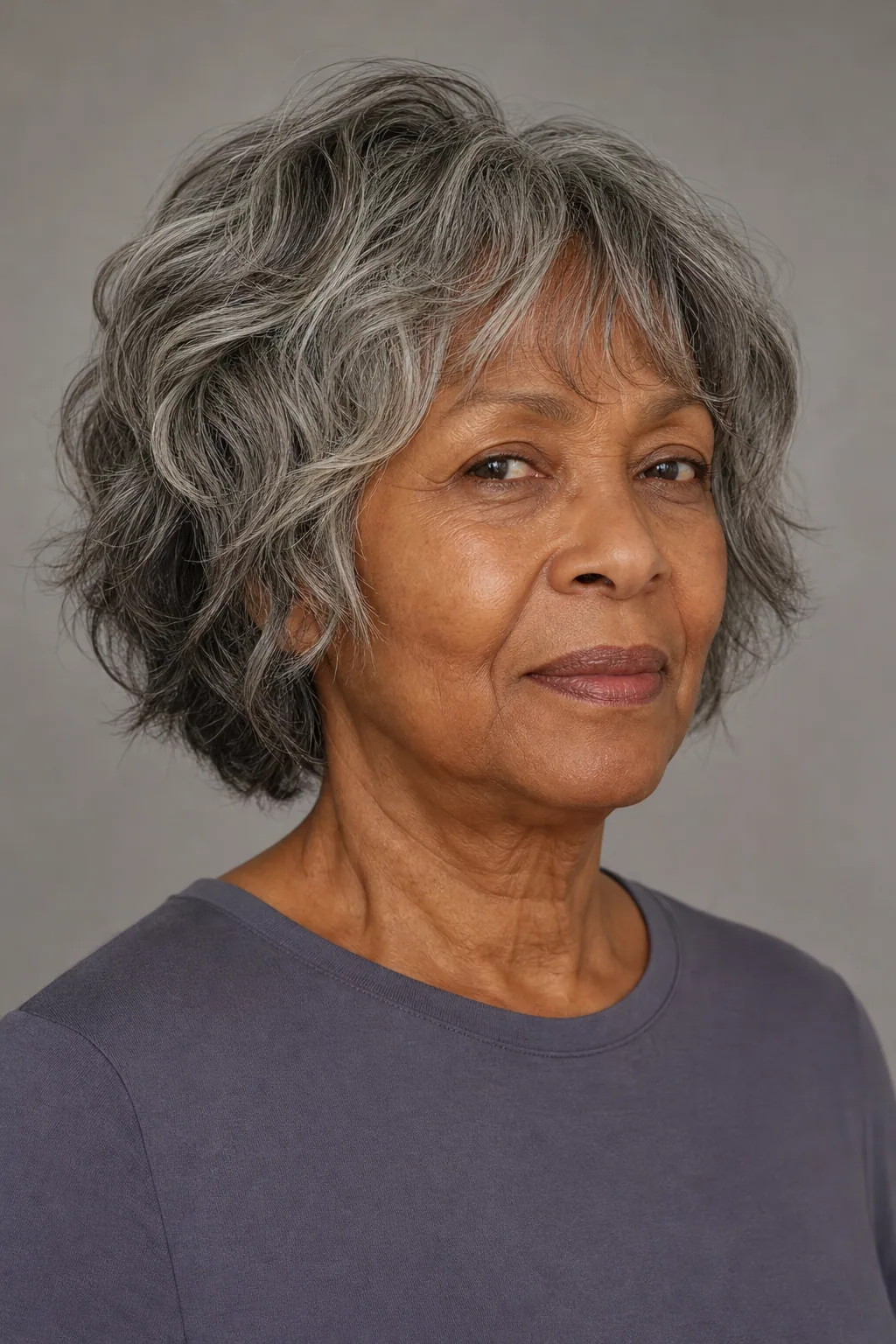
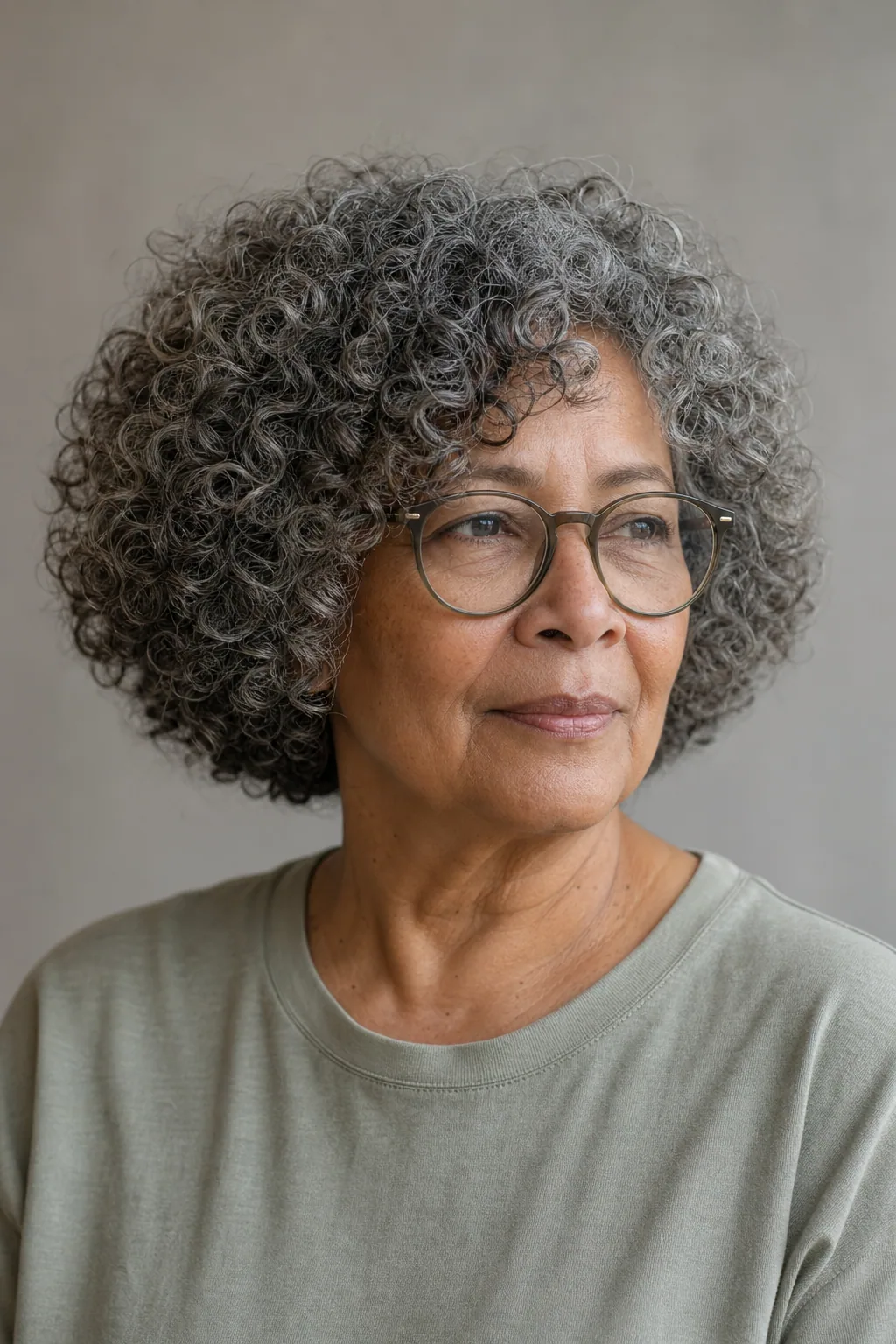
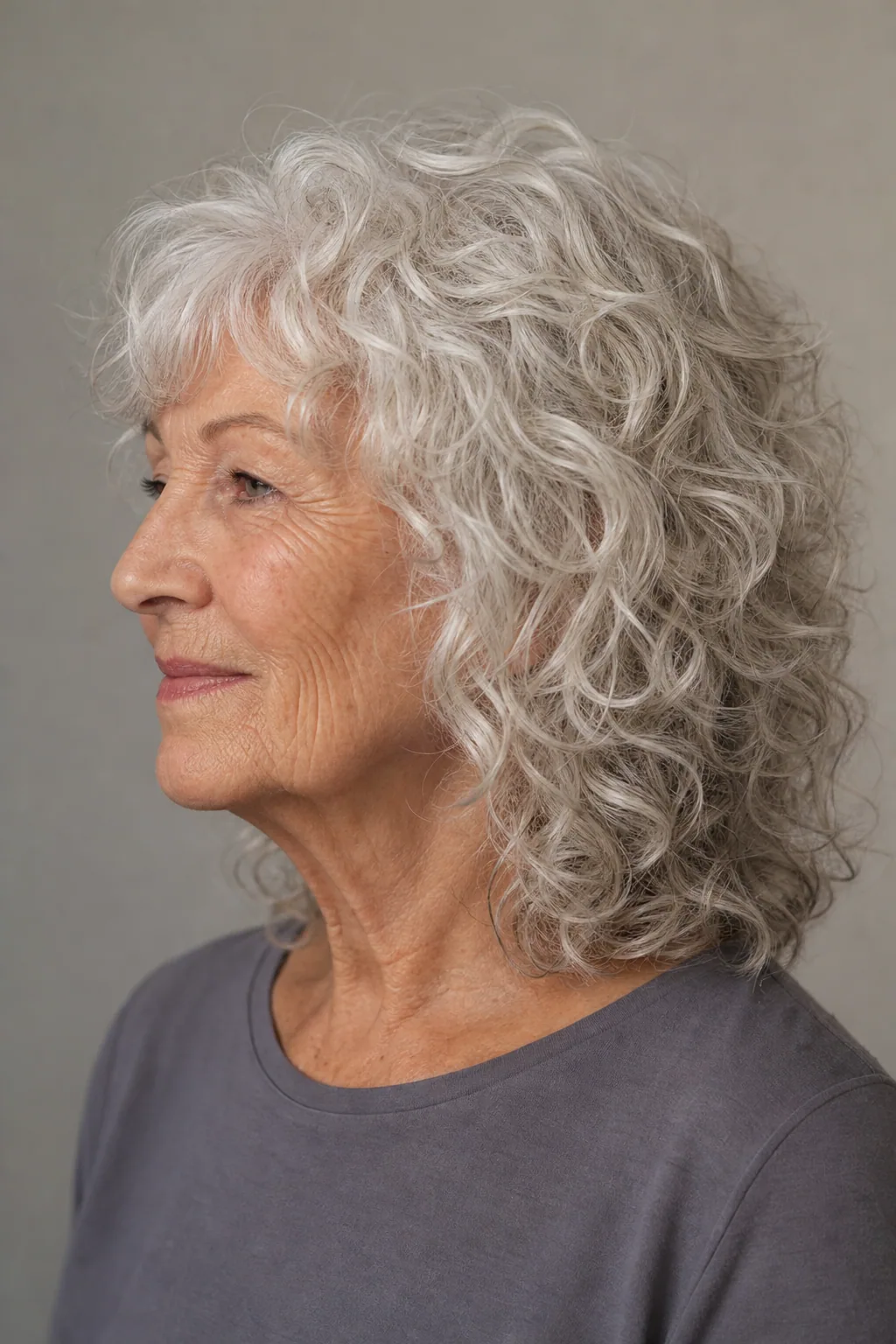
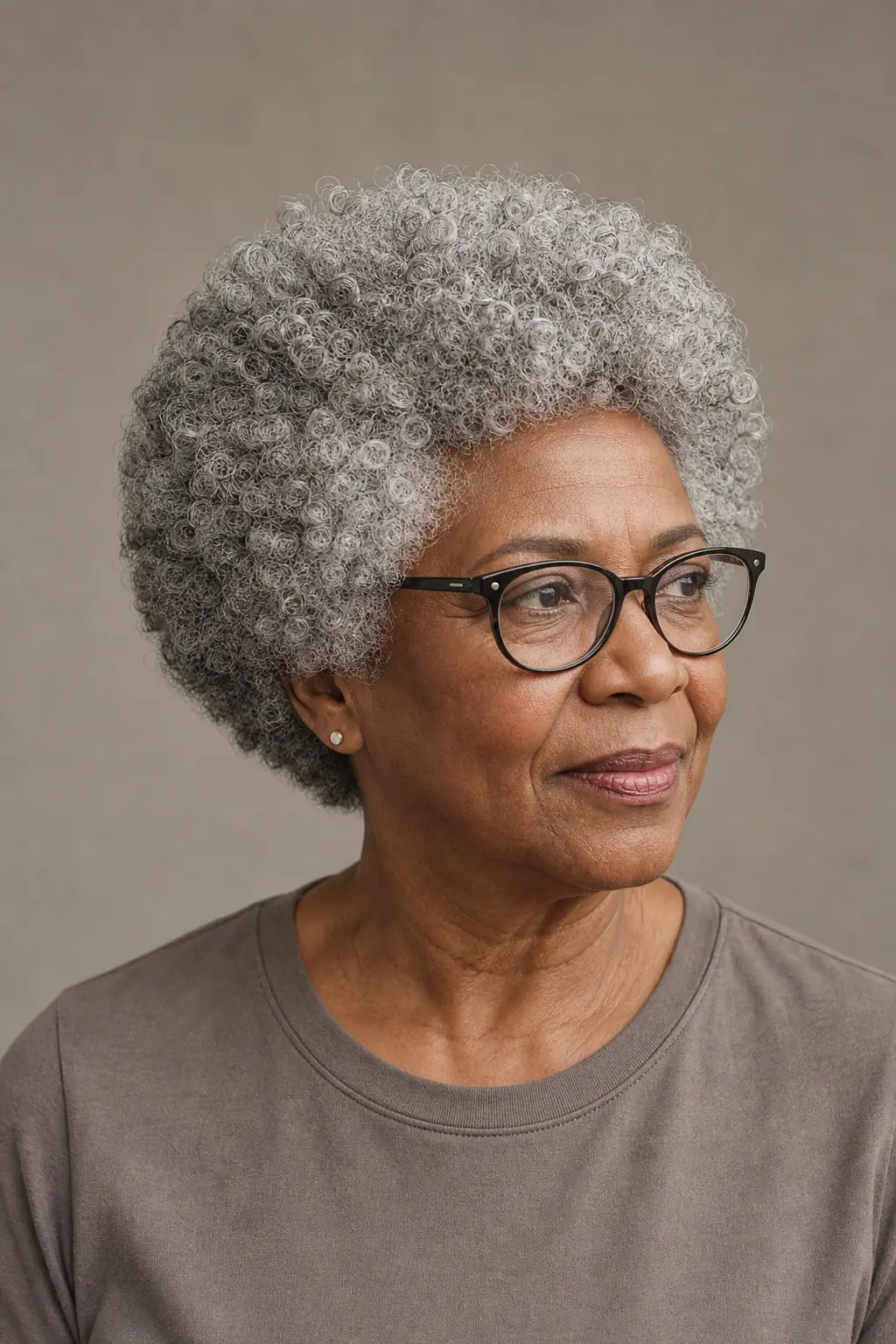
Wash-and-Wear Haircuts for Women Over 60: 12 Cuts by Hair Texture
By Coral Pleas, Founder of Cutting Loose Salon · Reviewed by Melissa Timperley · Updated November 2026 · 15 min read
Wash and wear haircuts for women over 60 depend on your hair's texture, not on its length: the cut that dries into shape on fine straight hair will puff up on thick hair and fall flat on wavy hair. Fine hair needs a few layers placed high, wavy hair needs its weight left in, thick hair needs weight taken out from inside and curly or coily hair needs cutting dry for the pattern it has now.
Below are 12 wash and wear haircuts for women over 60, grouped by texture, with how many minutes each one takes, how often it needs trimming and the salon words to ask for. They are also the low maintenance haircuts for women over 60 that hold a shape without a round brush. For the full range of lengths, see our guide to hairstyles for women over 60. If you want only short cuts, try short haircuts for women over 60, and for the decade on, hairstyles for women over 70 put air-dry ease first.
Hairstyle images in this guide are AI-generated illustrations, not photos of real clients or results. See our image standards.
What Wash and Wear Really Means
A wash and wear cut is one you can towel-dry, add one product to and style with your fingers or a few minutes of dryer, in under 10 minutes of hands-on time. It is not "no effort", and the easiest cuts often need the most frequent trims, because nothing is brushed back into shape between visits. What the cut does is let your hair do what it already wants to do. Some readers search for the same thing as wash and go haircuts.
Level of effort
What you do
Hands-on minutes
Cuts that fit
Air-dry only
Towel-dry, work one product through with your fingers, leave it alone
2–5, plus drying time
2, 4, 5, 9, 12
Dryer or diffuser, no brush
Towel-dry, one product, then dry with your fingers or a diffuser on low to medium heat
5–10
1, 3, 6, 7, 8, 10, 11
Dryer and round brush
Section, brush and smooth each piece
10–15
Not wash and wear; the cut needs the brush to finish
If a cut needs the third row to look right, the cut is the problem, not you. A well-made wash and wear cut should still look finished when the brush stays in the drawer.
Your Texture Decides the Cut
The same instruction fails across textures: "layer it so it's easy" helps fine hair stand up, but it strips the weight that wave needs and leaves thick hair full of short, bulky ends. So start with your texture, then pick the length. Texture here means the shape and thickness of each strand, and it can change in the 60s: gray hair often grows in coarser, and waves can appear or relax.
Texture
What the cut must do
What to ask for
Fine, straight
Hold lift at the roots without a brush; keep the outline solid so the ends don't look wispy
"A few short layers only at the crown, a near-solid edge around the bottom"
Thick or coarse, including coarse gray
Remove bulk from inside the cut; keep the ends clean so they don't puff
"Take weight out from underneath with scissors, and don't thin the ends"
Wavy
Leave weight in the ends so the wave forms an S instead of a puff
"Cut it as it falls, dry, and keep the ends full"
Curly and coily
Be cut dry for the pattern you have now, in a rounded shape
"Cut my curls dry, curl by curl, and leave room for them to spring up"
Wash and Wear Haircuts for Fine Straight Hair
Wash and wear haircuts for over 60 with fine hair work when the layers sit high and the outline stays solid. Layers through the whole head spread fine hair thin, so keep them to the crown, where you want the lift, and leave the perimeter close to one length.
1. Blunt Chin Bob With an Air-Dry Bend at the Ends
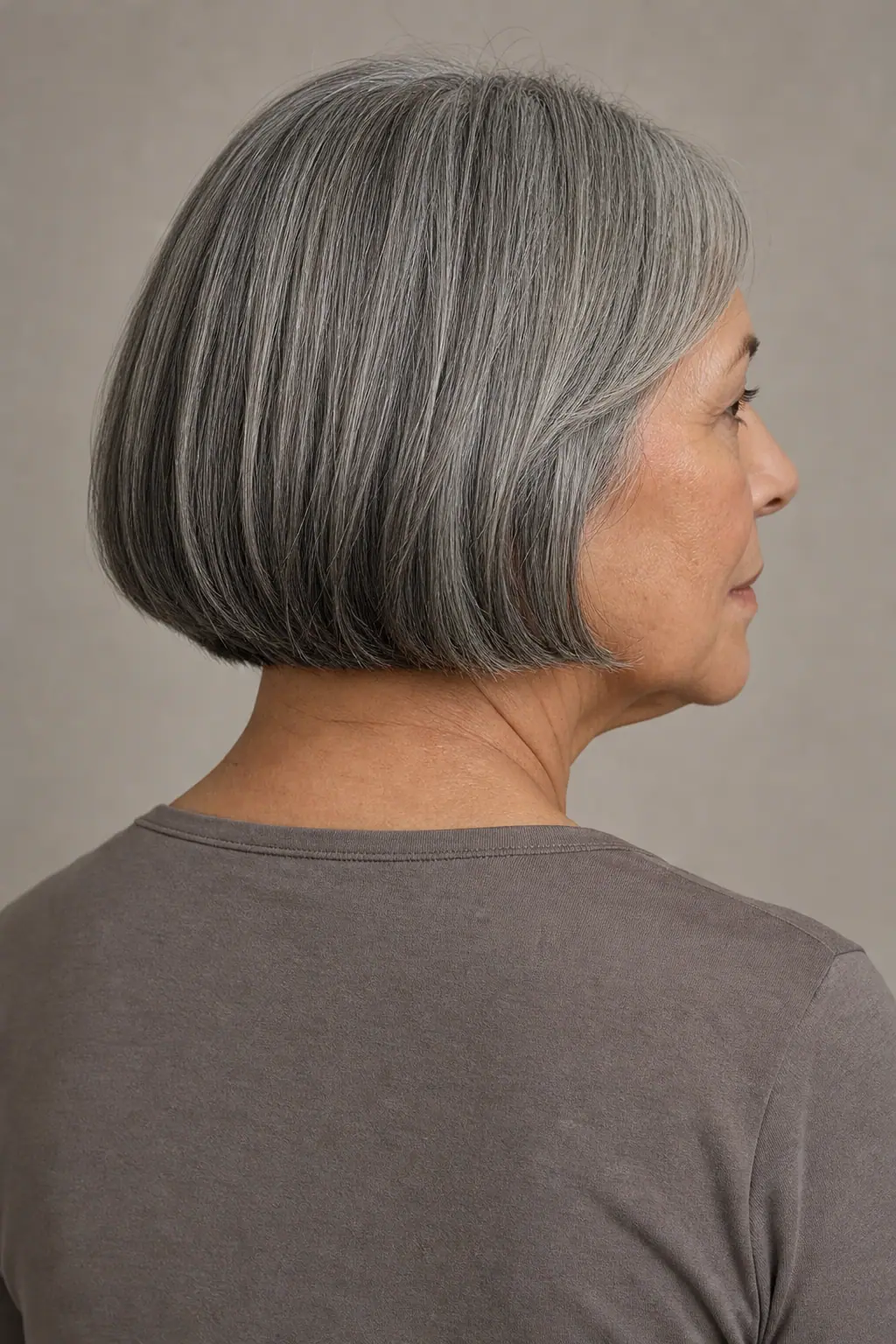
The hair is cut in one length at the chin, cut straight across, which is what a blunt edge means, and the corners are softened so the ends turn under on their own after towel-drying. The solid edge makes fine hair look denser at the bottom, where it tends to look sparse. Ask for "a blunt chin-length bob with the corners softened, so the ends bend under without a brush."
2. Soft Feathered Pixie for Fine Hair
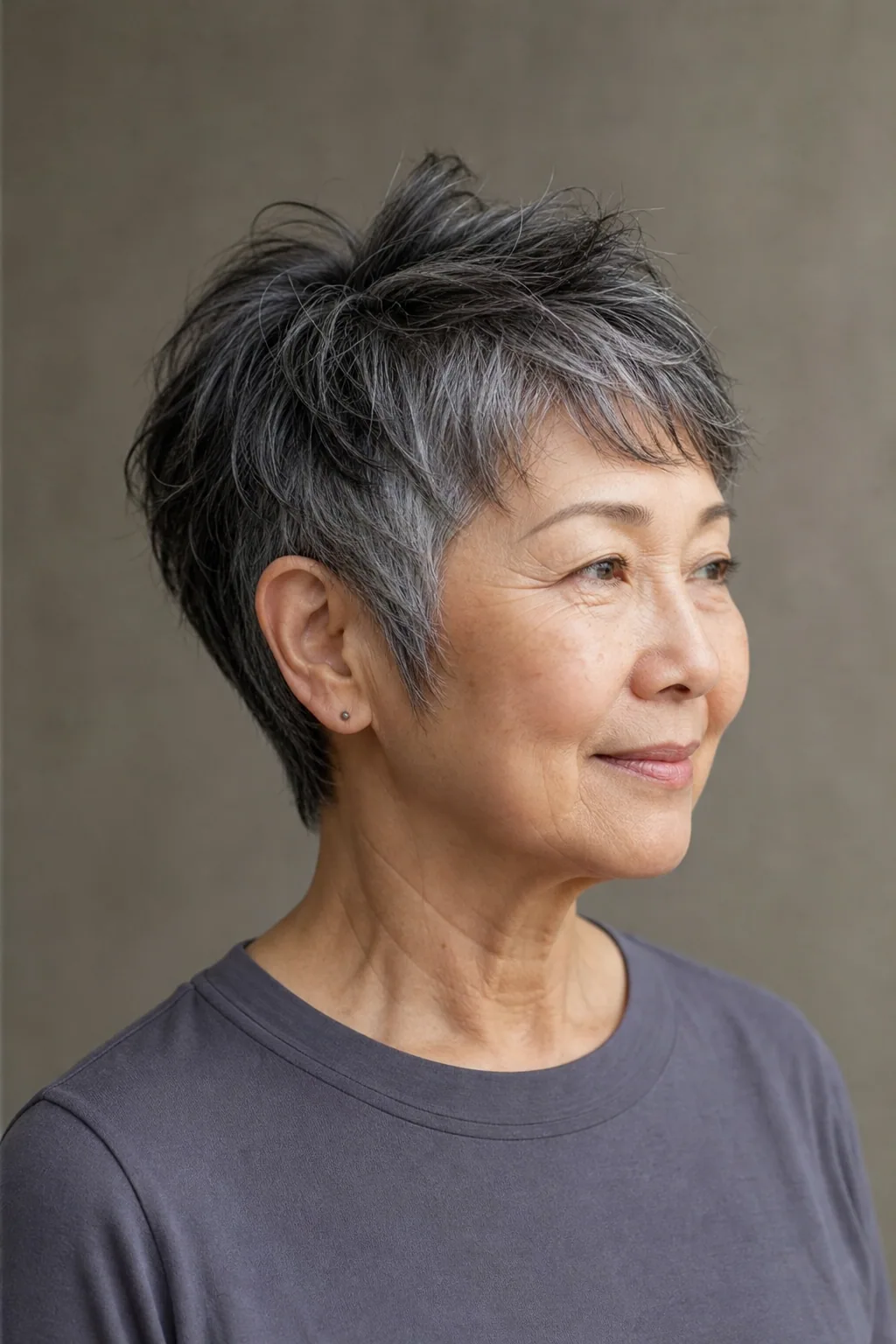
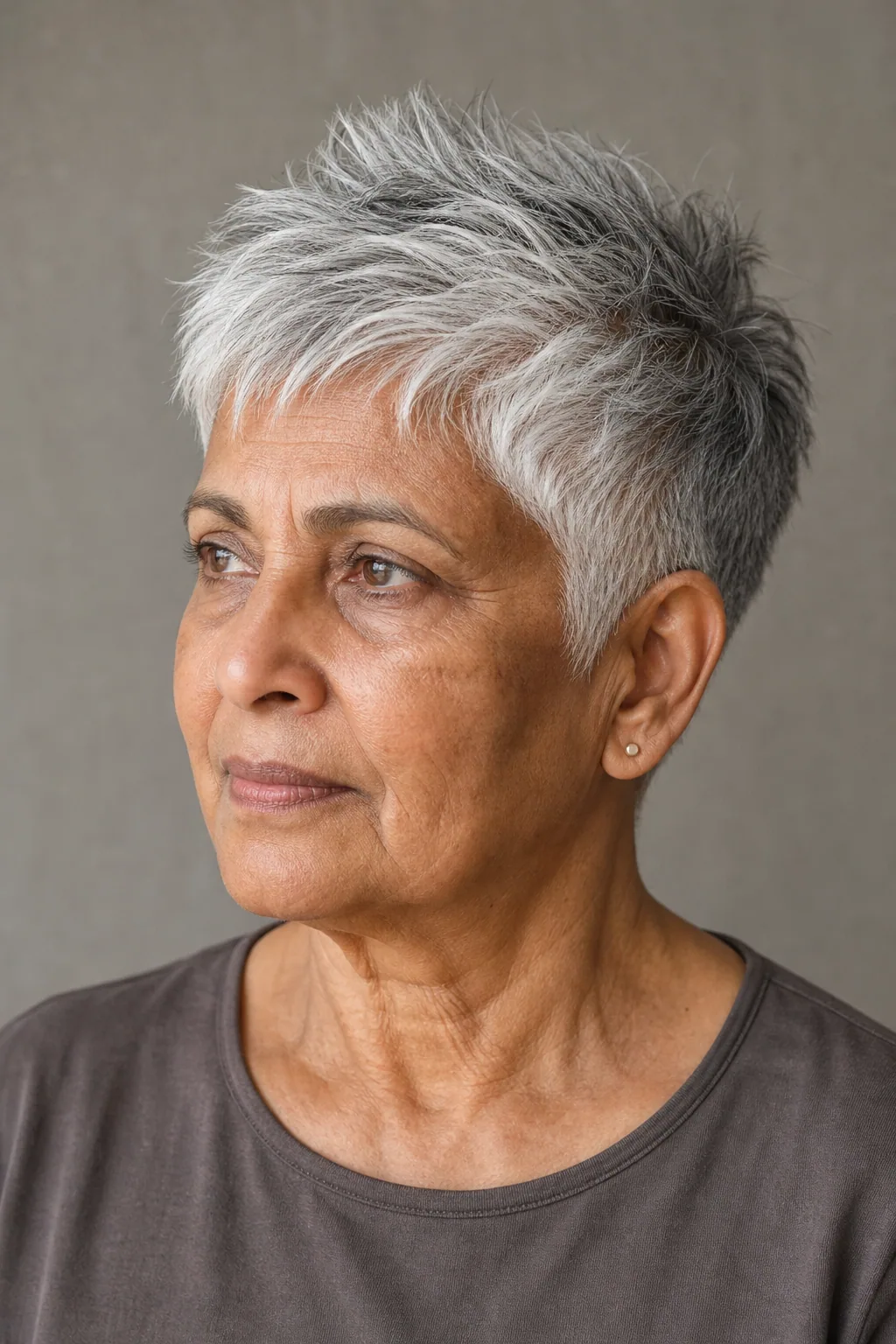
Here the lift is in the top. The top is left two to three inches, and the ends are feathered, cut with the scissors angled so each piece tapers to a wispy point rather than a blunt tip. On fine hair, that stops the top lying flat and gives you something to push up with your fingers in about two minutes. Use a pea-sized amount of light paste and no more, since fine hair goes limp with anything heavier.
3. Nape-Length Cut With a Few High Layers
Compare this to a cut with layers everywhere. Here the hair just brushes the nape, and only two or three short layers are cut through the crown, so the roots lift while the sides and back keep their length and weight. Towel-dry, spray a root lifter at the part and dry with your fingers for a few minutes. Ask for "a few short layers at the crown only, and leave the rest one length."
Wash and Wear Haircuts for Thick or Coarse Hair, Including Coarse Gray
Thick hair needs the opposite of fine hair: the weight comes out inside the cut, and the outside stays clean. Gray often grows in wirier and drier, so a cut that controls the bulk saves you the most time. If part of the thick hair is still dark and you're growing the color out, our guide on how to go gray covers the stages.
4. Short Bob With Weight Taken Out Inside
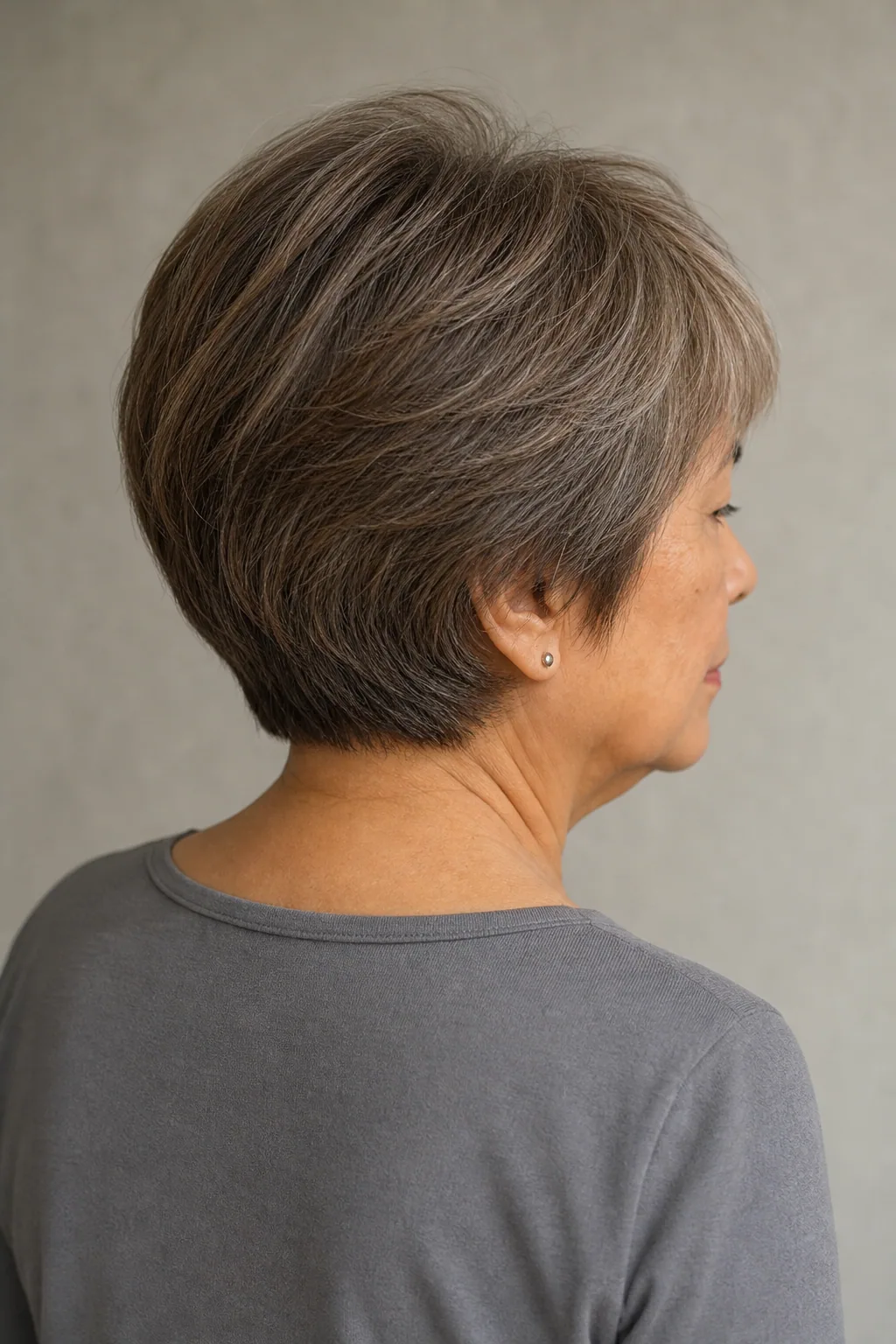
A jaw-length bob where the bulk is removed at the back, where thick hair stacks into a shelf. The stylist cuts shorter hair underneath at the nape, so the longer hair above lies over it and curves in instead of pushing out. The outline stays solid and the ends are not thinned. Smooth in a coin-sized amount of smoothing cream and leave it to dry.
5. Textured Crop With Close Sides for Thick Hair
The sides and nape are cut close, with clippers or scissor-over-comb (the scissors glide over a comb held against the head), while the top stays two to three inches and is point cut so it breaks into pieces. The close sides take away the part of thick hair that spreads, and the top does the rest. This is the quickest option here: no more than three minutes with a little cream, and a trim every 4–6 weeks.
6. Collarbone Cut With Long Layers for Thick Gray Hair
At the collarbone, thick hair widens toward the bottom into a triangle. Long layers that start at the chin release that weight and let the hair fall in, and the ends stay blunt so the gray looks clean. It suits readers who want length and ten weeks between trims. Work a leave-in conditioner through the ends, comb once and let it dry.
Wash and Wear Haircuts for Wavy Hair
Wave needs weight to form: strip it out and the wave puffs, leave it in and the wave falls into an S-shape. So wavy cuts here keep the ends full and are cut the way the hair falls, ideally dry, so you see the wave before you commit to a length.
7. Wavy Bob With the Weight Left in the Ends
Between the chin and jaw, cut with no thinning shears anywhere. The weight in the ends pulls each wave into a curve, and a handful of light mousse scrunched in while damp is all it needs. Ask for "a wavy bob cut dry, as it falls, with the ends left full." If your wave sits only at the back, say so.
8. Shoulder-Length Waves With a Curtain Fringe
A curtain fringe is parted in the middle and swept to each side, and on waves it is cut dry, longer than a straight fringe, so it settles into your wave rather than springing up. The rest is one length at the shoulders with a few long layers. It suits an oval or long face, and it needs five to eight minutes with a diffuser on low.
9. Short Wavy Shag Cut to Air-Dry
A shag is layered all over, shortest on top, so the layers stack in the wave instead of hanging flat. Here the layers sit above the jaw and are cut where your waves spring up, which is why it works best cut dry. It is looser than a bob and dries in four minutes with a texturizing spray and your fingers. Skip heavy razoring on gray hair, which frizzes at the ends.
Wash and Wear Haircuts for Curly and Coily Hair
Curly and coily hair is the texture most often cut wrong: cut wet and stretched straight, it springs up shorter and uneven. Cutting dry, curl by curl, shows where each curl actually sits, and a rounded shape keeps the outline even as it dries.
10. Rounded Curly Bob Cut Dry
The curls are cut in sections while dry, and the outline is rounded, like a soft dome, with the shortest curls near the crown so the sides don't spread into a triangle. Scrunch in a curl cream and a light gel while it is soaking wet, then dry with a diffuser on low or leave it alone. Ask for "a rounded bob cut dry, with the curls left to spring up."
11. Shoulder-Length Curls With Long Layers
Long layers start below the chin and are cut one curl at a time, so the curls don't stack into a pyramid. The length keeps the weight that holds the pattern, and it's the one curly option here that stretches to eight to ten weeks. Pat, don't rub, with a microfiber towel, then scrunch in a curl cream and diffuse on low.
12. Rounded Coily Shape at Two to Three Inches
Coily hair sits at two to three inches when it dries, and the cut follows that: even length all round, no taper, shaped into a soft, rounded outline. Wash with conditioner in, work in a water-based leave-in, then lift the shape with a wide-tooth pick and let it dry. Trims every 4–6 weeks keep the round from losing its edge.
The Five-Minute Routine for Each Texture
Each texture has one towel method, one product and one way to dry, and getting those three right is most of the work. Start with a small amount of product; you can add, but you can't take it out.
Fine straight hair: blot with a microfiber towel (do not rub). Work a golf-ball-sized amount of root-lift mousse or a few sprays of root lifter through the roots, then dry with your fingers on medium heat for two to three minutes, lifting at the part. Flip your head over for the last 30 seconds.
Thick or coarse hair: squeeze out water with a towel, then comb a coin-sized amount of smoothing cream or leave-in conditioner through the lengths and ends with a wide-tooth comb. Air-dry, or use a dryer on low with a nozzle for three to five minutes. Avoid touching it as it dries.
Wavy hair: scrunch the water out with a microfiber towel, then scrunch a palm-sized dollop of light mousse or wave cream through. Diffuse on low to medium heat for five minutes, and don't touch it until it's dry.
Curly and coily hair: detangle with conditioner in while it's wet, then apply a leave-in and a curl cream or light gel in small sections while soaking wet. Scrunch, then air-dry or diffuse on low. When it's fully dry, shake it out with your fingers.
Wash and Wear With Thin Hair
A cut changes how full thin hair looks, not how much there is. For wash and wear haircuts for over 60 with thin hair, the job is a solid outline and lift at the roots. A solid outline, one length at the bottom, is what makes the hair look dense, and lift at the crown keeps the scalp from showing through. That's why entries 1, 3 and 7 suit lower density, while a pixie shows more of the scalp if the top is cut too short. For more on cuts for lower density, see the over-60 hub. If hair loss is sudden or patchy, see a board-certified dermatologist.
Choose by Face Shape
Air-dry cuts follow your face shape the way any cut does, but without the brush to correct them, so the shape has to be right at the start. For the full method, see how to choose a haircut for your face shape.
Face shape
Good picks here
Key detail
Avoid
Oval
1, 7, 8
Most of these work, so choose by texture
A heavy fringe that hides the forehead
Round
3, 5, 6
Height at the crown and length past the chin lengthen the face
A chin-length cut with width at the cheeks
Square
2, 8, 9
Soft, feathered or wavy edges near the jaw take off the corners
A blunt line that stops at the jaw
Heart
1, 4, 7
Fullness at or below the chin balances a wider forehead
Lots of volume at the temples
Long
7, 8, 10
Width at the sides and a fringe shorten the face
Length with no layers or fringe
What to Ask Your Stylist
Say how you will actually style it: "wash, towel, go." A cut that looks right under the dryer in the salon can fail at home, so ask for a finish done the way you'll do it. Say these out loud:
"I want to wash it, towel it and go. Cut it so it dries into shape without a brush."
"Dry it in the chair the way I'll do it at home: towel, one product, fingers."
"Cut my hair dry, so you can see how it falls."
"I have thick hair. Take weight out from underneath, and don't thin the ends." (Or: "Fine hair. Layers at the crown only.")
"Show me how it grows out, and tell me when the next trim is due."
Maintenance and Styling Reality
The easiest cuts need the most frequent trims, and the longer ones trade minutes for weeks. Pick the trade-off that fits your week. If you're weighing a short cut for the same reason, our guide to short haircuts for women over 60 compares the ladder from pixie to bob.
Cut (entries)
Trim every
Hands-on minutes
Products by category
Tools
Grow-out
Fine bob or nape-length cut (1, 3)
6–8 weeks
4–6
Root-lift mousse or spray
Dryer with a 1-inch nozzle, wide-tooth comb
Very even
Feathered pixie (2)
4–6 weeks
2–3
Light paste
Fingers only
Awkward over the ears
Thick short bob and crop (4, 5)
4–6 weeks
3–5
Smoothing cream
Microfiber towel, wide-tooth comb
The nape thickens first
Thick collarbone cut (6)
8–10 weeks
5–8
Leave-in conditioner
Wide-tooth comb
Loses the layers slowly
Wavy bob, waves and shag (7, 8, 9)
6–8 weeks
4–8
Light mousse or wave cream
Diffuser, 4–5 inches across, on low heat; microfiber towel
Bangs join the waves; the shag needs reshaping
Curly bob and layers (10, 11)
6–8 weeks (11: 8–10)
8–10
Curl cream, light gel
Diffuser on low, wide-tooth comb
Even; layers soften
Coily shape (12)
4–6 weeks
5
Water-based leave-in, a light butter
Wide-tooth pick
The round loses its edge first
When you grow one of these out, the trick is to avoid a lopsided stage: ask for a "shape-up," not a cut, between visits, and see our short haircuts for women over 50 if you're moving down from longer hair.
Frequently Asked Questions
What is the best wash and wear haircut for over 60 with thin hair?
A blunt chin-length bob (entry 1) or a nape-length cut with a few high layers (entry 3). A solid edge makes the outline look fuller, and layers at the crown give lift without a brush. Skip layers through the sides, which let thin hair look sparse.
Can you get a wash and wear haircut with fine hair?
Yes. Fine hair does well with a few layers at the crown and a near-solid outline, dried with your fingers. Use a light product, because creams and oils weigh it down. If it goes flat by noon, ask for the layers to sit higher.
Is a pixie the only wash and wear option?
No. Pixies dry fastest but need a trim every 4–6 weeks. A wavy bob, a rounded curly bob or a collarbone cut with long layers dries just as easily and goes 6–10 weeks. Choose by texture first, then by how often you want to visit.
How often should a wash and wear cut be trimmed?
Every 4–6 weeks for pixies and crops, 6–8 for bobs and every 8–10 for longer layered cuts. With no brush to correct it, the shape shows a grown-out edge sooner. Book the next visit before you leave.
Can I air-dry gray hair without frizz?
Often, yes. Gray tends to be coarser and drier, and most frizz comes from rubbing it with a towel and touching it while it dries. Blot with a microfiber towel, work a smoothing cream through while damp, comb once and leave it. If the ends are split, only a trim fixes that.
What product do I need for wash and wear hair?
One product, picked by texture: root-lift mousse for fine hair, smoothing cream for thick hair, light mousse or wave cream for wavy hair and a curl cream, with a light gel if you want hold, for curly and coily hair. Start with a small amount, since too much weighs fine hair down.
Are there wash and wear haircuts for long hair?
Yes, but fewer, because long hair takes longer to dry and shows weight more. The easiest is one length with a few long layers starting below the chin, like entries 6 and 11 at the collarbone. Past the shoulders, plan on the clip.
Results vary with hair type, density, texture and face shape. This guide is educational and is not a substitute for an in-person consultation with a licensed stylist.
 Grace