Hairstyles for Women Over 50 With Glasses: 12 Cuts That Work With Your Frames
By Coral Pleas, Founder of Cutting Loose Salon · Reviewed by Melissa Timperley · Updated November 2026 · 11 min read
The best hairstyles for women over 50 with glasses work around three points: the top rim of the frames, the arms over your ears and the weight of the frame itself. Glasses draw a horizontal line across the face, so a fringe should sit just above that line or sweep past it, never rest on it, and the sides should either clear the arms cleanly or fall over them lightly. Bold frames want a little more height or softness in the cut, while fine or rimless frames let the cut do more.
Below are 12 cuts for women over 50 who wear glasses, from pixie to long layers, matched to frame types, with the salon words to ask for and honest trim times. For the whole range of cuts at this age, see our guide to haircuts for women over 50, and for the method behind these choices, how to choose a haircut for your face shape. For lift and movement on top, see youthful hairstyles over 50.
Hairstyle images in this guide are AI-generated illustrations, not photos of real clients or results. See our image standards.
The Three Places Your Glasses Meet Your Hair
Your glasses and your hair meet in three places: the top rim, the arms and temples, and the weight of the frame. Each one has a typical way of going wrong, and each has a plain instruction for your stylist. After 50 there are two extra factors. Hair at the temples is often finer, so short pieces over the arms can look sparse. And many of us wear progressive or reading glasses, which makes the lower half of the lens matter as much as the top.
Where they meet
What goes wrong
What to ask for
Top rim
A fringe that rests on the rim lifts the frame, smudges the lens and pokes at the lashes
"Cut the fringe so it sits just above the top rim, or long enough to sweep to the side past it"
Arms and temples
Hair bunches under the arms, pushes the frame out or snags at the hinge
"Sides that clear the arms, or fall over them lightly. Nothing trapped underneath"
Frame weight
A heavy frame swallows a flat cut, and a delicate frame gets lost behind a bulky one
"Add height or softness for bold frames. Keep the shape simple for fine or rimless ones"
You are wearing the frame every day, so it is part of the haircut. Think of it as a feature you are cutting around, not one to hide.
Match the Cut to Your Frames
The frame you wear most decides which cut to start with. Match its weight, shape and width, and use the entry numbers below to see the cut in the gallery.
Your frames
What balances them
Entries
Bold or thick acetate
Height on top, soft layers or a side sweep, and a fringe that clears the rim by a finger's width
3, 8, 10
Thin metal or rimless
Clean lines and shape: angled bobs, tapered sides, a sleek fringe
2, 5, 7
Cat-eye
Fullness at the sides and a fringe that follows the upward tip of the frame
6, 11
Oversized
Length and volume to match the frame's width, hair swept back or long enough to balance it
9, 4
Round
Some angle or height, so the cut doesn't repeat the circle
1, 5, 8
Rectangular
Soft curves and rounded layers to offset the straight lines
4, 6, 10
Short Cuts That Work Around Frames
Short cuts give you the most control over where the hair meets the glasses, because there is less of it to catch. They also show more of the face, so frame shape and fringe length matter more.
1. Pixie With a Fringe Cut Above the Top Rim
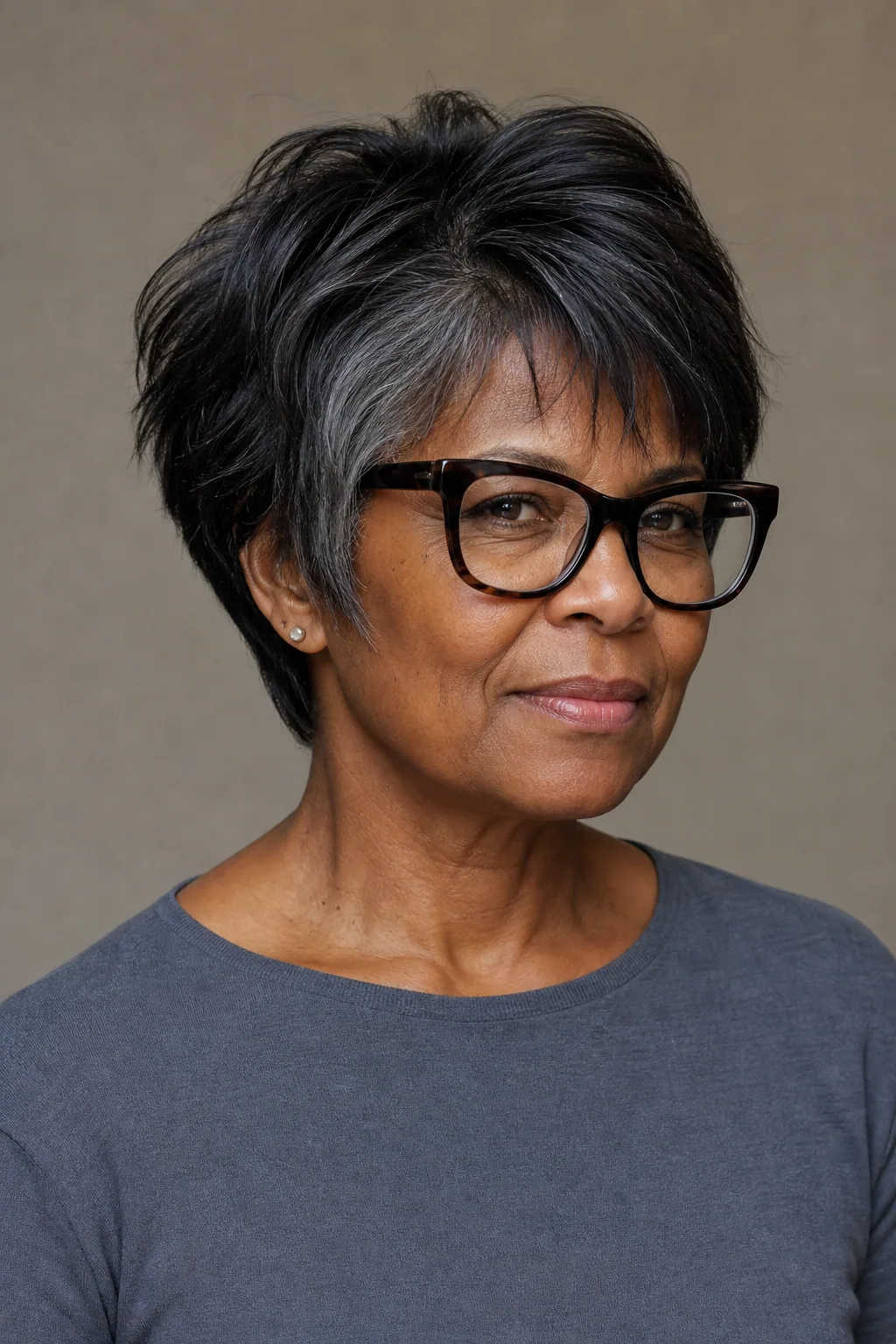
The fringe is the cut here. It is shaped slightly longer in the middle and cut with your glasses on, so it ends about a finger's width above the rim and never touches the lens. The rest of the pixie stays short and light. It suits a round or rectangular frame, where the fringe adds an angle. Ask for "a pixie with the fringe cut above my frames, checked with the glasses on."
2. Bixie With Sides That Fall Lightly Over the Arms
This bixie, a cross between a bob and a pixie, is about arm weight, not hearing aids. The sides are cut to the bottom of the ear and point cut, with the scissors snipped upward into the ends, so the hair lies thin over a fine metal arm instead of lifting it. It suits thin metal frames with slim arms. If your arms are thick, taper the hair above the ear instead. Ask for "soft sides that lie over the arms, not on top of them."
3. Short Layered Cut With Height That Balances Bold Frames
A heavy frame can swallow a flat crop. This cut keeps the top longer and layers it so the crown stands off the head, which gives the face enough lift to hold a thick acetate frame. The sides are cut close enough to leave the arms clear. Dry it with your fingers and a root-lift spray, about five minutes. Say "height at the crown to balance a bold frame."
Bobs That Clear the Arms
A bob keeps weight at the jaw, which suits glasses because the length sits away from the lenses. The question is where the sides land relative to the arms.
4. Chin-Length Bob That Ends Below the Arms
Because the bob finishes at the chin, the sides hang below the arms and cover them from the front, with no bulk trapped behind the ear. A soft, curved line at the chin sits well with a round or rectangular frame. It dries in 8–10 minutes with a medium round brush and holds for 6–8 weeks. Ask for "a chin-length bob, sides that hang below my arms, the line curved, not blunt."
5. Angled Bob for Rimless or Thin Metal Frames
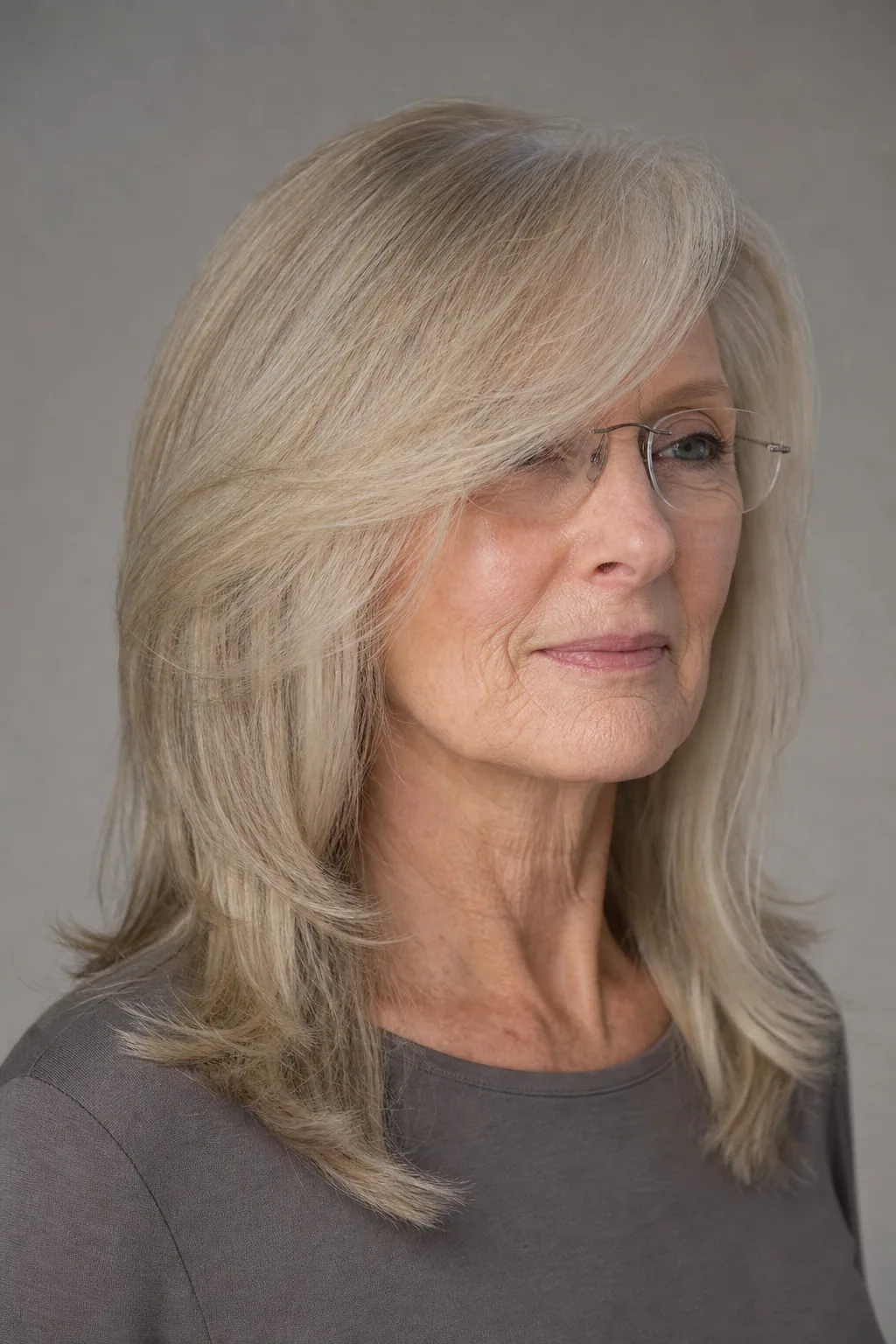
An angled bob is cut shorter at the back and longer toward the face. Light frames have little visual weight of their own, so the hair gives the face shape, and the slope points toward the lenses without crowding them. Keep the fringe off the face, side-swept or absent. Ask for "an angled bob, shorter at the back, with the front at the chin and no fringe on my frames."
6. Bob With Curtain Bangs That Part Around the Lenses
Curtain bangs are parted in the center and swept to each side. Cut a little longer than usual, they pass over the top rim and fall at the outer edge of each lens, not across it. They work with a cat-eye or rectangular frame, where the bangs follow the frame's line. Have them cut with your glasses on and trimmed every 3–4 weeks, since they reach the rim first.
Medium and Long Cuts With Glasses
Longer hair works with glasses when the layers begin below the lenses and the sides don't gather behind the ear. For more shoulder-length options, see our guide to medium-length hairstyles for women over 60.
7. Shoulder-Length Cut With Face-Framing Layers That Start Below the Lenses
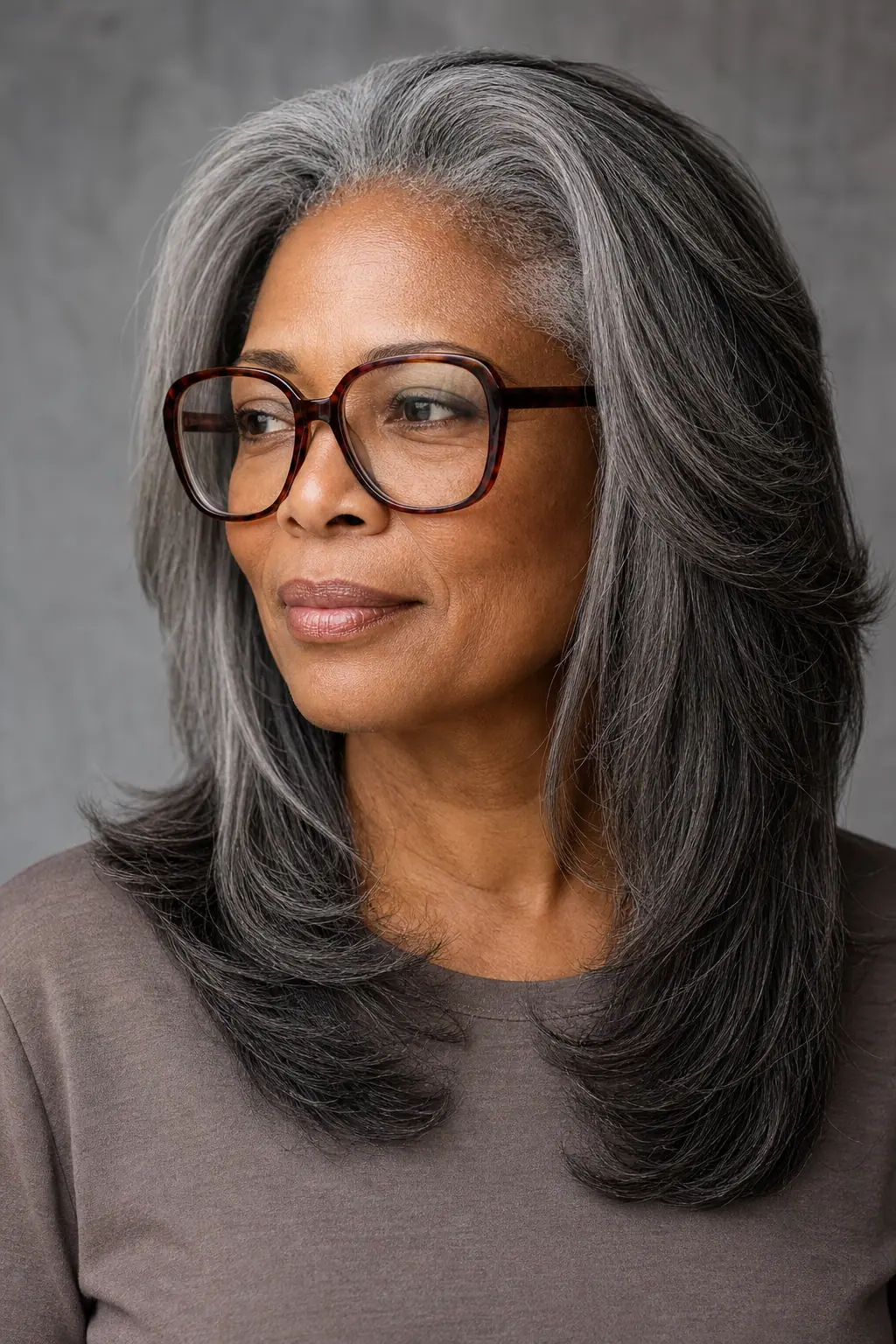
The shortest layer begins at the bottom of the lens or below, so nothing short crowds the frame and the hair shapes the cheekbone and jaw instead. It suits thin metal or oval frames and hair that goes flat at the sides. Blow-dry the layers away from the face with a 1.5-inch round brush, about 10 minutes. Ask for "face-framing layers that start under my glasses, not beside them."
8. Collarbone Lob Worn Tucked Behind One Ear
Tucking one side shows the frame and keeps the hair out of the lens. Cut the tucked side a little longer, an inch or so, so it stays behind the ear and over the arm, and keep the other side loose. It works with bold frames and with a face that wants a little asymmetry. A light smoothing cream stops the tuck from springing out. If you'd rather not tuck, wear it loose; the cut stays the same.
9. Long Layers Swept Back for Oversized Frames
A large frame can overpower a short cut, so this one has length and movement to match it. The layers are long and blended, and the front is swept back and away from the lens, which keeps the frame in view and the hair out of it. It suits fine to medium density, and the ends need trimming every 8–10 weeks. Ask for "long layers, blended, with the front long enough to sweep back."
Texture and Special Cases
Curly, coily and progressive-lens wearers each need a different adjustment, and the first two are about where the volume sits. These three cuts handle them.
10. Curly Bob With the Volume Kept Above the Frames
Curl takes up room, and at the sides it can push the arms out. This bob is cut dry, curl by curl, with the volume kept above the frames and the sides shaped close enough to sit under the arms. It suits round or rectangular frames, thick or thin. Use a light cream and diffuse on low, then fluff the crown. Ask for "a curly bob shaped dry, with the width above my glasses, not at the temples."
11. Coily Tapered Cut With Clean Temples
The sides and temples are tapered close so the arms rest on skin, which stops coily hair from being pushed or flattened by the frame. The top keeps its length and shape. Any frame works; cat-eye and bold acetate are the two to see in a mirror first. Moisturize before styling, and plan a trim every 4–6 weeks to keep the temples crisp. Say "taper the temples so my arms sit clean."
12. Long Side-Swept Fringe for Progressive Lenses
With progressives you look through the lower part of the lens to read and the upper part for distance, so a fringe has to stay out of both zones. This one is cut long, to the cheekbone or lower, and swept to one side, so it never crosses the lens. It suits a high forehead and rimless or thin frames. Have it cut with your glasses on and ask for "a long fringe that sweeps past the lens."
Bangs and Glasses: Where the Fringe Should Sit
The fringe is the one part of the cut that touches the frame, so it needs a set length. A short fringe sits just above the top rim, about a finger's width. A long fringe sweeps to the side and passes the rim without resting on it. The space in between is the problem: hair that lands right on the rim lifts the glasses and smudges the lens. Heavy blunt bangs are the hardest to keep in that range, so a wispy or side-swept shape is usually easier. For the shape of bangs by face, see our guide to choosing a haircut for your face shape.
Progressive Lenses, Readers and Sunglasses
Progressive and reading glasses change what the cut has to do, because you move your head and the glasses more. A few practical points:
Keep hair out of the lower lens. Anything that crosses the lower half of a progressive lens gets in the way when you read. Sides and fringe should clear it.
Don't push readers up on your head. They flatten the crown and pinch the hair at the arms. Hang them on a cord or keep them in a case, and the lift from the cut will last.
Dark lenses hide the hairline but not the shape. If you wear sunglasses most of the day, the arms are the part to watch, because the hair around them is what is seen.
Have the lenses fitted before the cut. If your frames change, the fringe and sides may need to be adjusted.
Glasses and Gray Hair
Frame color affects how silver or salt-and-pepper hair reads, so it is worth a look before the next pair. Dark frames in black, charcoal or navy give silver hair a crisp outline, while tortoiseshell and warm colors can soften it and add warmth. Very pale or clear frames fade into white hair. Try on a few against your hair color in daylight and pick the one you reach for. For help with the color itself, see our guides to going gray and blending gray into dark hair.
A heavy fringe that covers the forehead and the rim
Round
1, 3, 5, 8
Height on top and length at the front
Width at the cheeks with a round frame
Square
4, 6, 7, 10
Soft layers and curves at the jaw
A blunt line that ends at the jaw
Heart
5, 6, 8, 11
Fullness at or below the chin
Volume at the temples
Long
6, 9, 10, 12
Width at the sides and a fringe
A tall cut with no fringe
What to Ask Your Stylist
Wear your glasses during the consultation, and bring the frames you wear most. The fringe and side lengths need to be cut with the frames in place. Say these out loud:
"I'm wearing the frames I wear most. Please cut the fringe and the sides with them on."
"The fringe should sit above the top rim, or be long enough to sweep past it. Nothing resting on the rim."
"The sides should clear the arms or fall over them lightly. Nothing bunched underneath."
"My glasses are bold (or fine), so I need a little more height (or a simpler shape)."
"I use progressives (or readers). Keep the hair out of the lower lens."
Maintenance and Styling Reality
Glasses add one trim: the fringe and the sides need a touch-up before the rest of the cut does. Book it in between full cuts.
Cut (entries)
Trim every
Daily styling
Products and tools
Grow-out
Pixie and bixie (1, 2)
4–6 weeks
3–8 minutes
Paste or clay; fingers only
Fringe first, then sides over the arms
Short layered cut (3)
5–7 weeks
5–8 minutes
Root-lift spray
Grows into a bob
Bobs (4, 5)
6–8 weeks
8–12 minutes
Smoothing cream; round brush
Even and forgiving
Bob with curtain bangs (6)
6–8 weeks (bangs 3–4)
8–15 minutes
Heat protectant; small round brush
Bangs join the layers
Shoulder and lob (7, 8)
8–10 weeks
10 minutes
Light smoothing cream
Very forgiving
Long layers (9)
8–10 weeks
5–10 minutes
Leave-in conditioner
Easy, keep the front shaped
Curly and coily (10, 11)
5–7 weeks
10–15 minutes
Curl cream, diffuser on low
Gradual
Long fringe (12)
6–8 weeks (fringe 4)
5 minutes
Light cream
Fringe joins the sides
Frequently Asked Questions
What haircut is best with thick or bold glasses?
Choose one with height or softness at the crown, because a heavy frame can swallow a flat cut. Layers on top, or a bob with a gentle curve, work well. Keep the fringe above the rim by about a finger's width.
Why do my bangs stick to my lenses?
Bangs that rest on the rim pick up oil from your skin and the lens. The fix is a shorter fringe or one long enough to sweep aside. If they still touch, ask your optician to adjust the nose pads to move the glasses slightly away from your face.
Can I tuck my hair behind my ears with glasses?
Yes, if the hair is long enough to stay behind the ear and the arm is slim. A thick arm can push tucked hair out or leave a bump. Cut the tucked side an inch longer, and use a light cream to hold it.
How do I stop my hair catching on my glasses?
Catching happens at the hinge, where short layers over the ear get trapped. Ask for the layers to be cut longer there or tapered clear of the arm, and use a light smoothing cream on dry, staticky hair. Brush it before you put on the glasses.
Do glasses look better with short or long hair over 50?
Both work, and the frame matters more than the length. Short cuts show the frame, and long layers can balance an oversized one. Choose the length you will style, and have the fringe and sides cut with the frames on.
What hairstyle works with progressive lenses?
Choose a cut that keeps hair out of the lower half of the lens, such as a long side-swept fringe or an angled bob with the front at the chin. Avoid a short fringe that sits mid-lens. Wear your progressives to the appointment so the stylist can check it.
What color frames suit gray hair?
Dark frames in black, charcoal or navy give silver hair a crisp outline, and tortoiseshell adds warmth. Pale or clear frames can disappear against white hair. Try several against your hair in daylight and pick the pair you reach for.
Results vary with hair type, density, texture and face shape. This guide is educational and is not a substitute for an in-person consultation with a licensed stylist.
 Grace