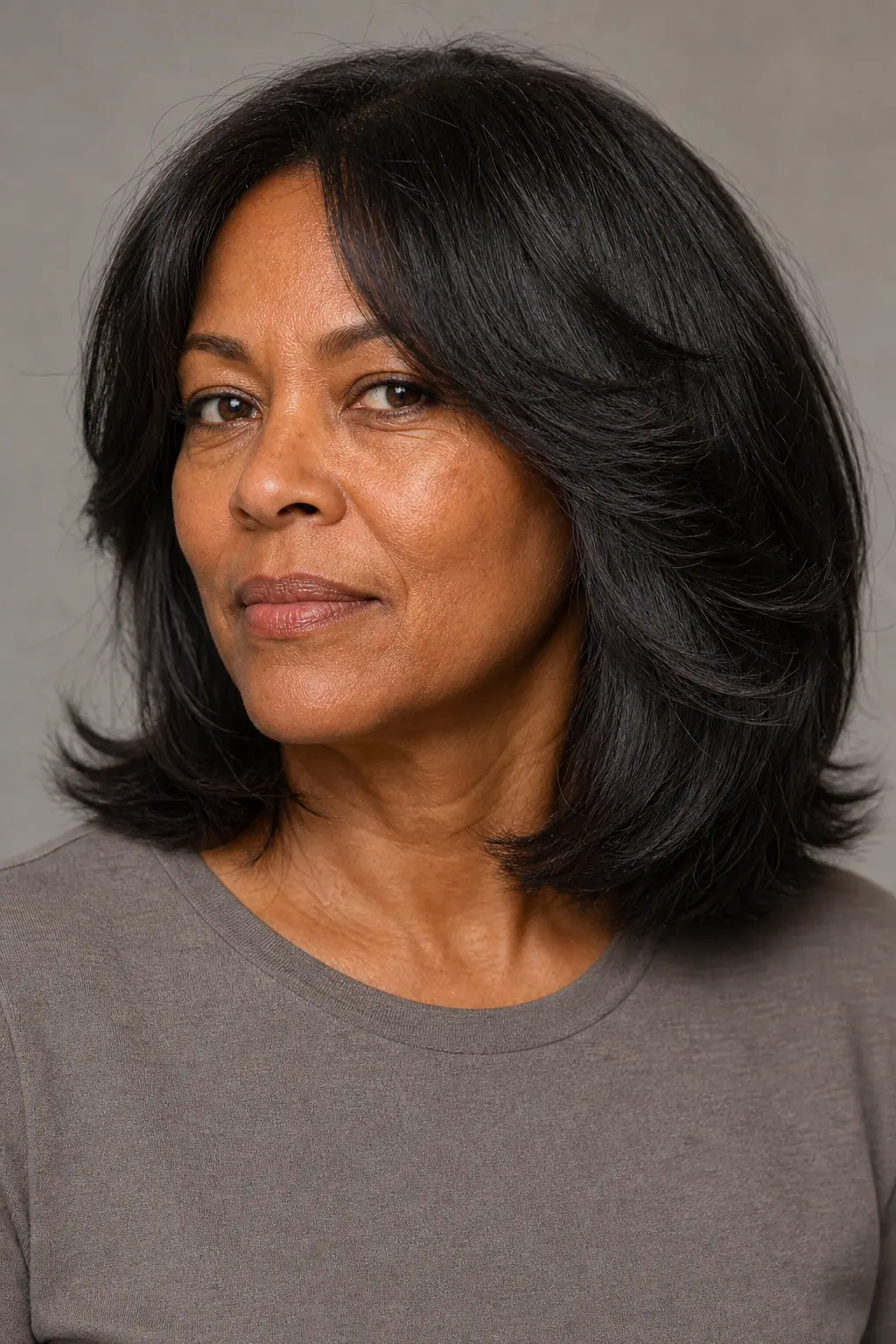
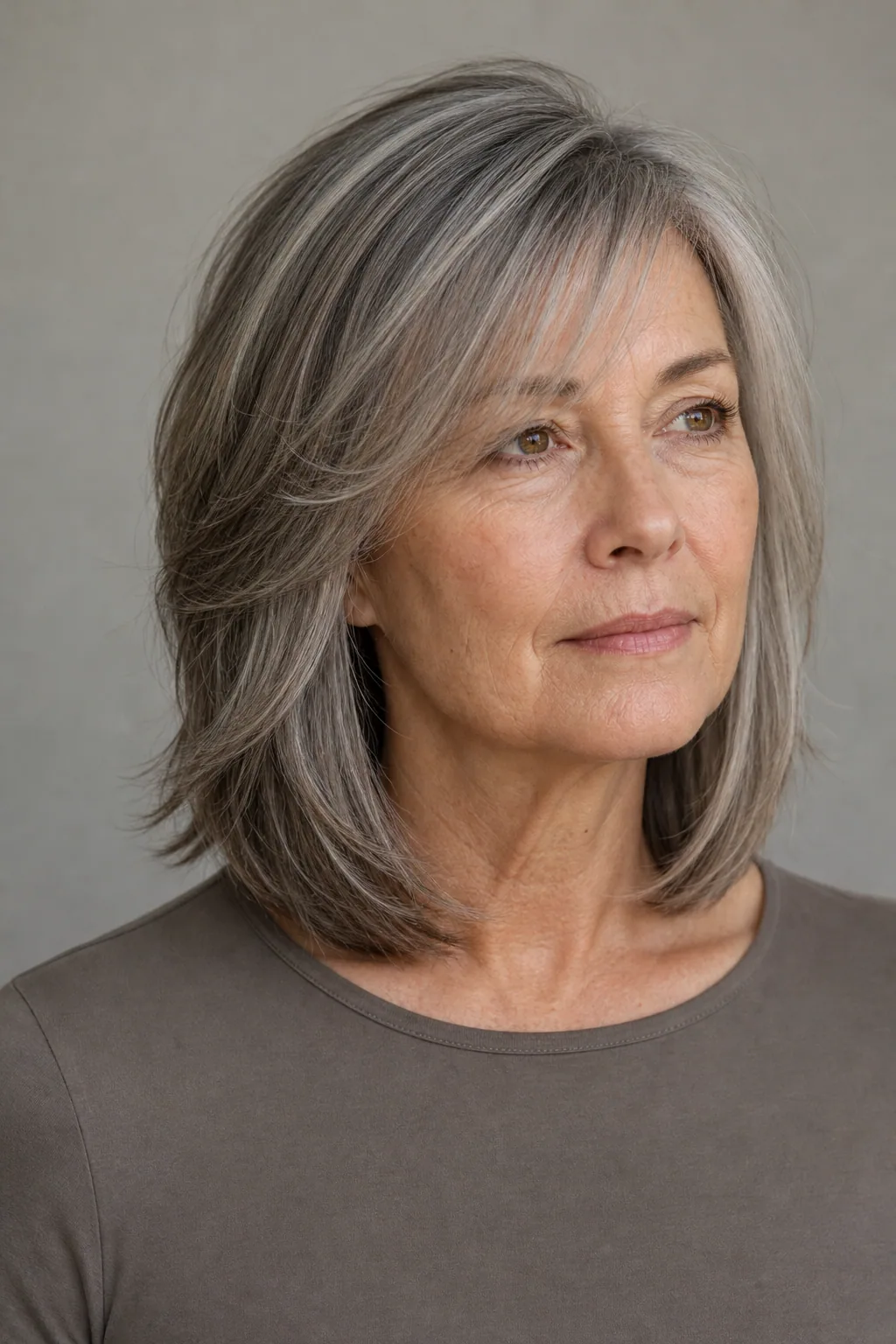
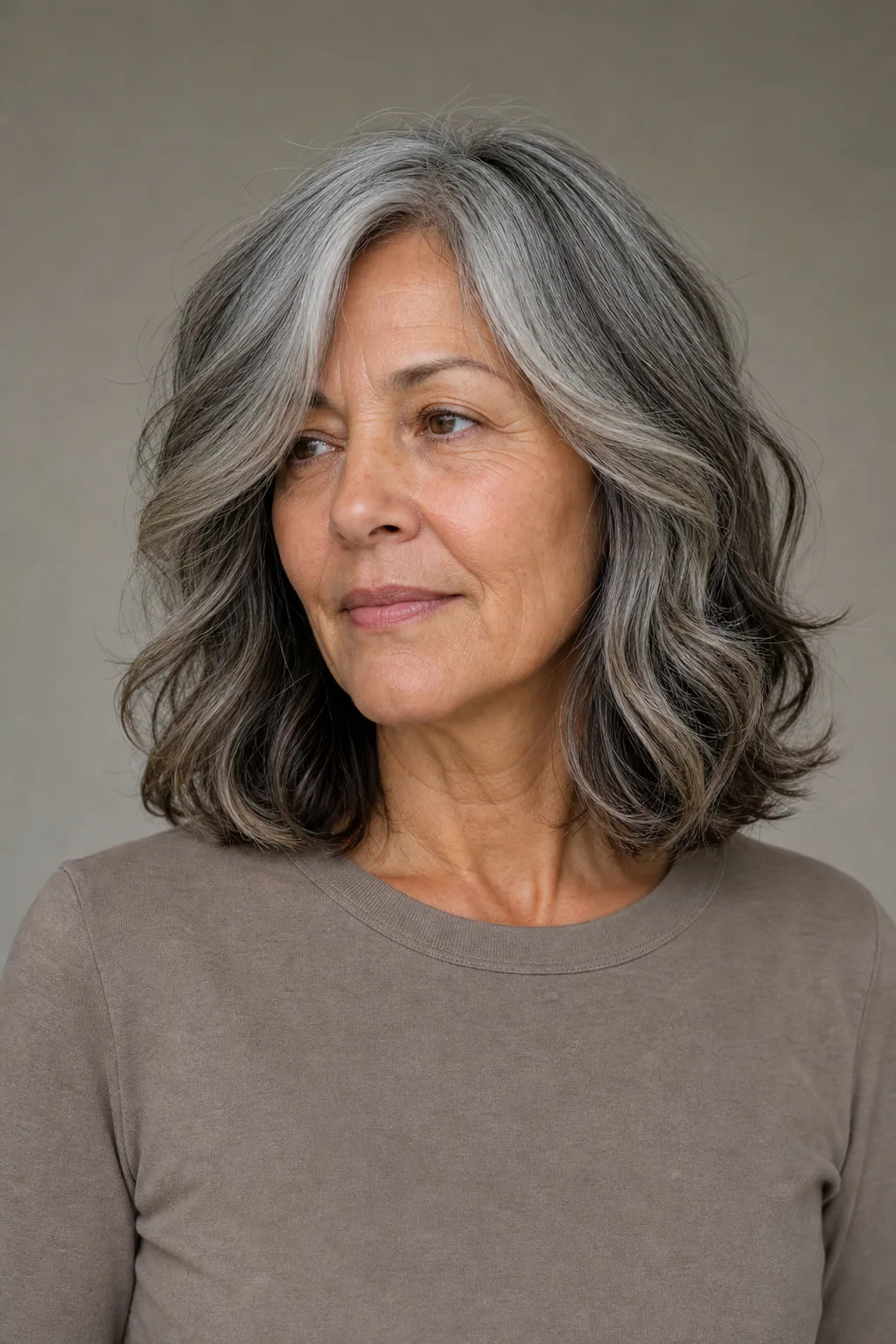
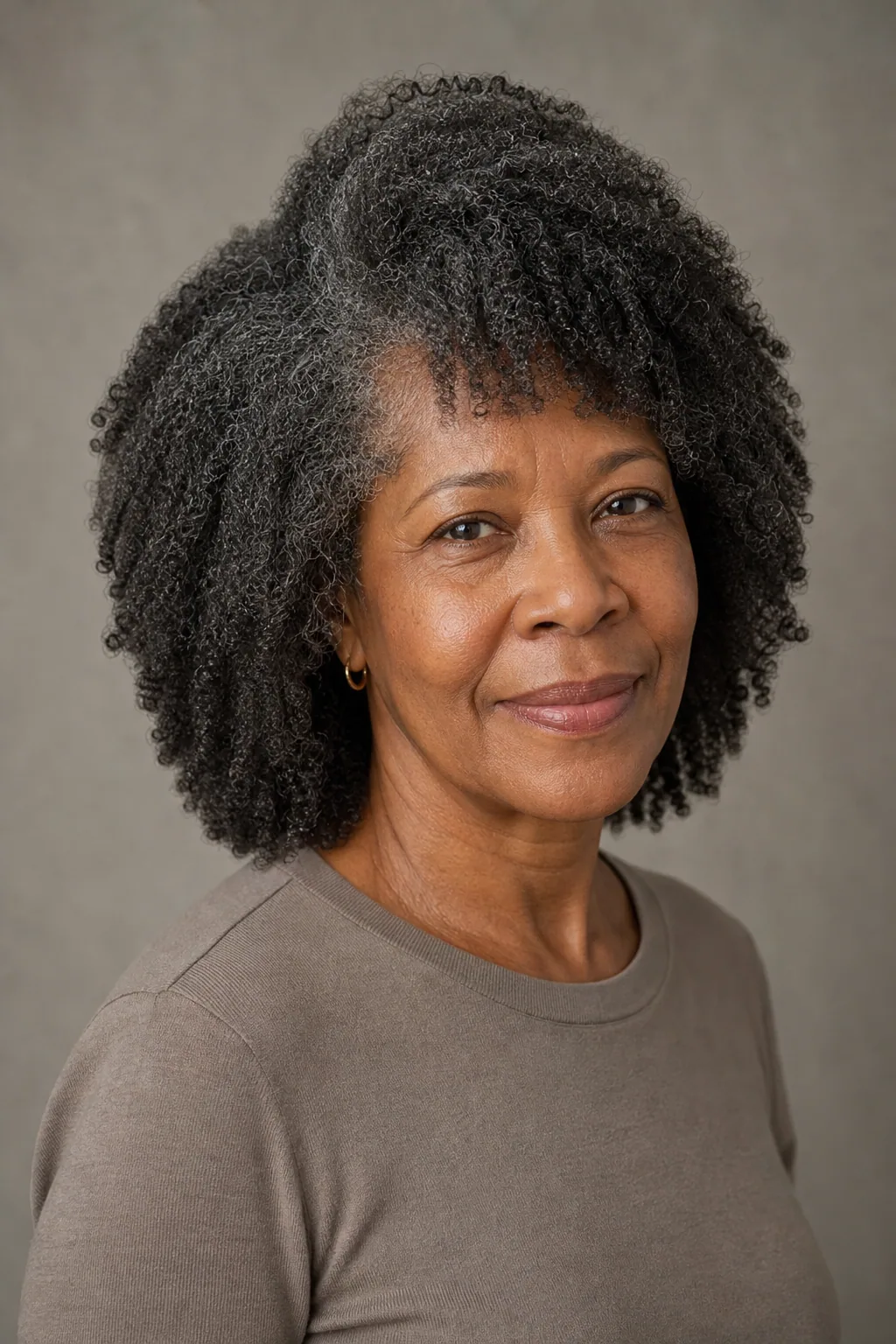
Medium-length hairstyles for women over 50, cut anywhere from the jaw to just below the collarbone, are the best compromise at this age: long enough to tie back, short enough to keep their body. Around 50, density often starts to shift toward the crown and the part, and a medium cut lets the stylist put lift on top while the ends stay full. For many women the sweet spot is the in-between length just below the collarbone, which has become the new "long" after 50.
Below are 12 medium cuts for women over 50, grouped by lobs, layers, bangs and texture, with who each suits and the salon words to ask for. After the gallery you'll find a length chart, quick ways to style medium hair, how to go from long to medium, cuts by face shape and hair type, and who should choose something shorter. For every length at this age, see our guide to haircuts for women over 50. A decade on, medium-length hairstyles for women over 60 ask more of the ends, and a decade earlier, haircuts for women over 40 start with an outgrown cut.
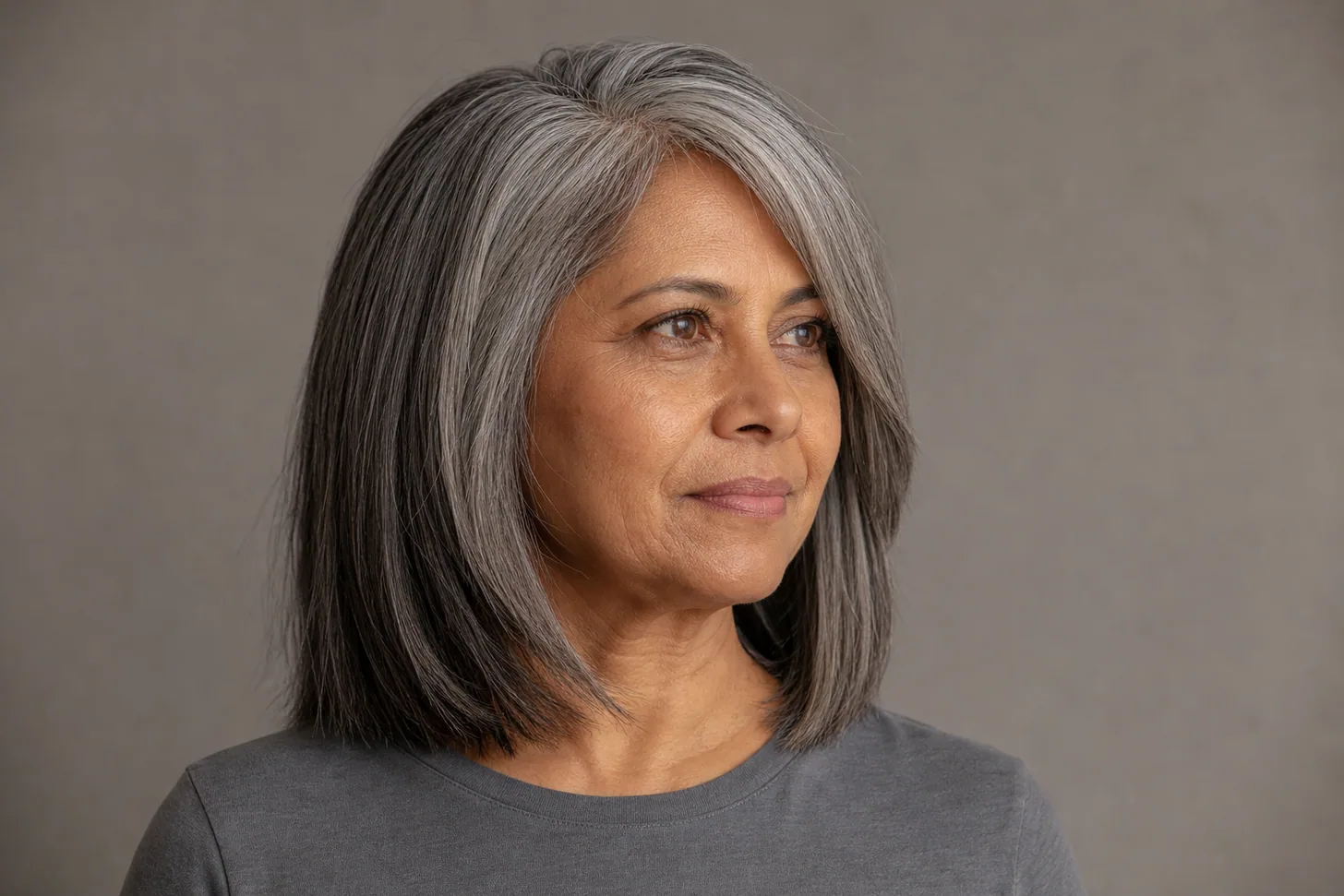
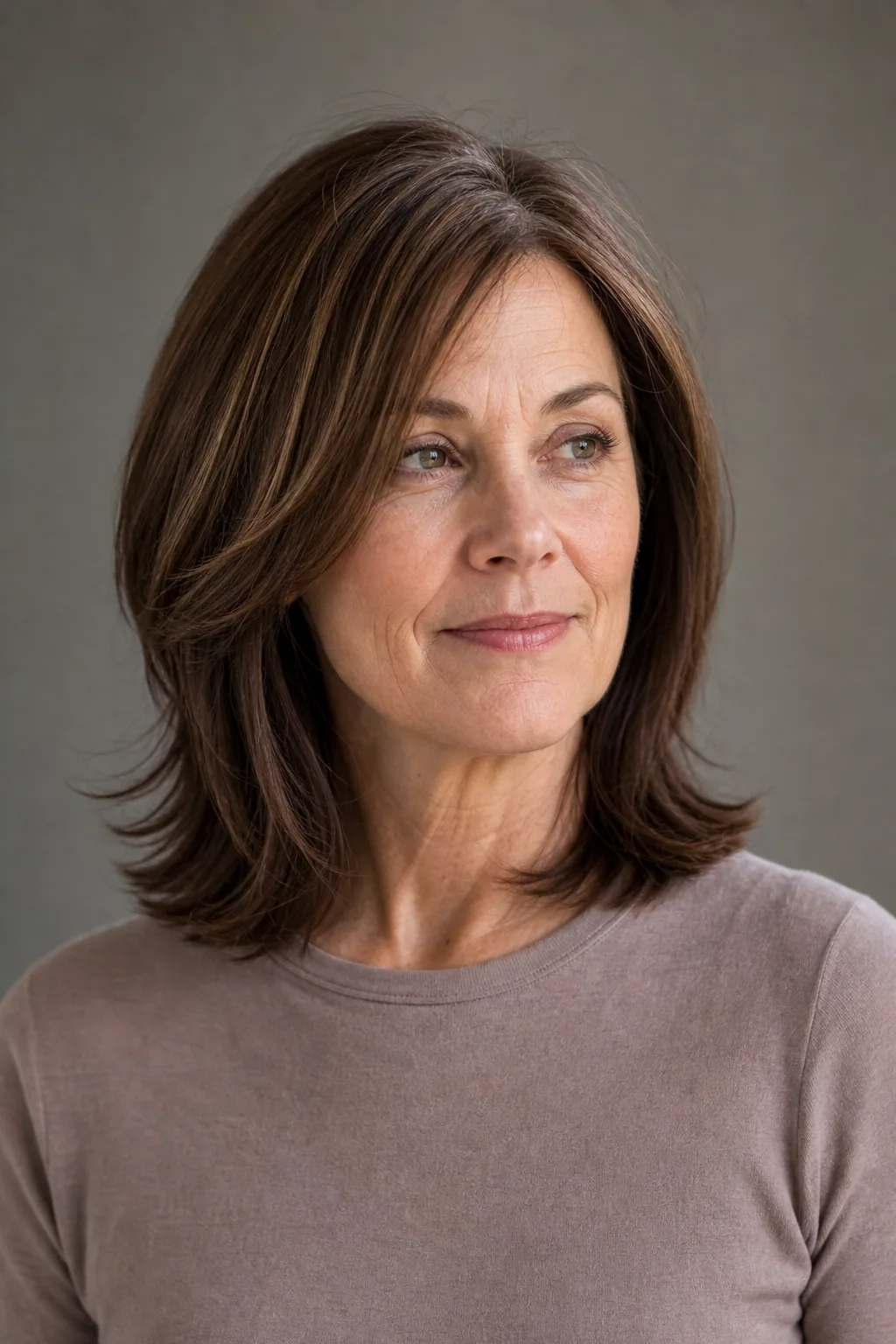
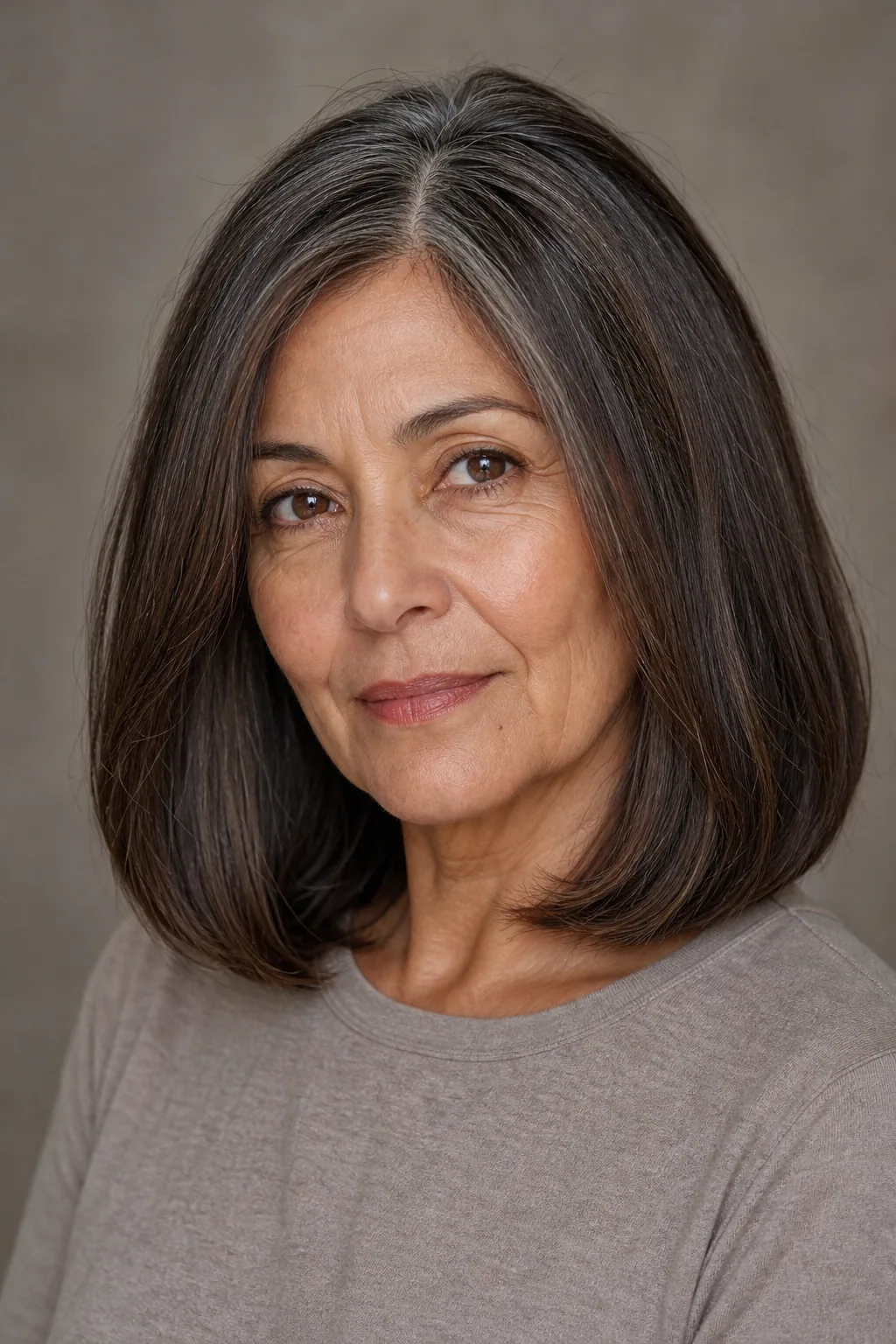
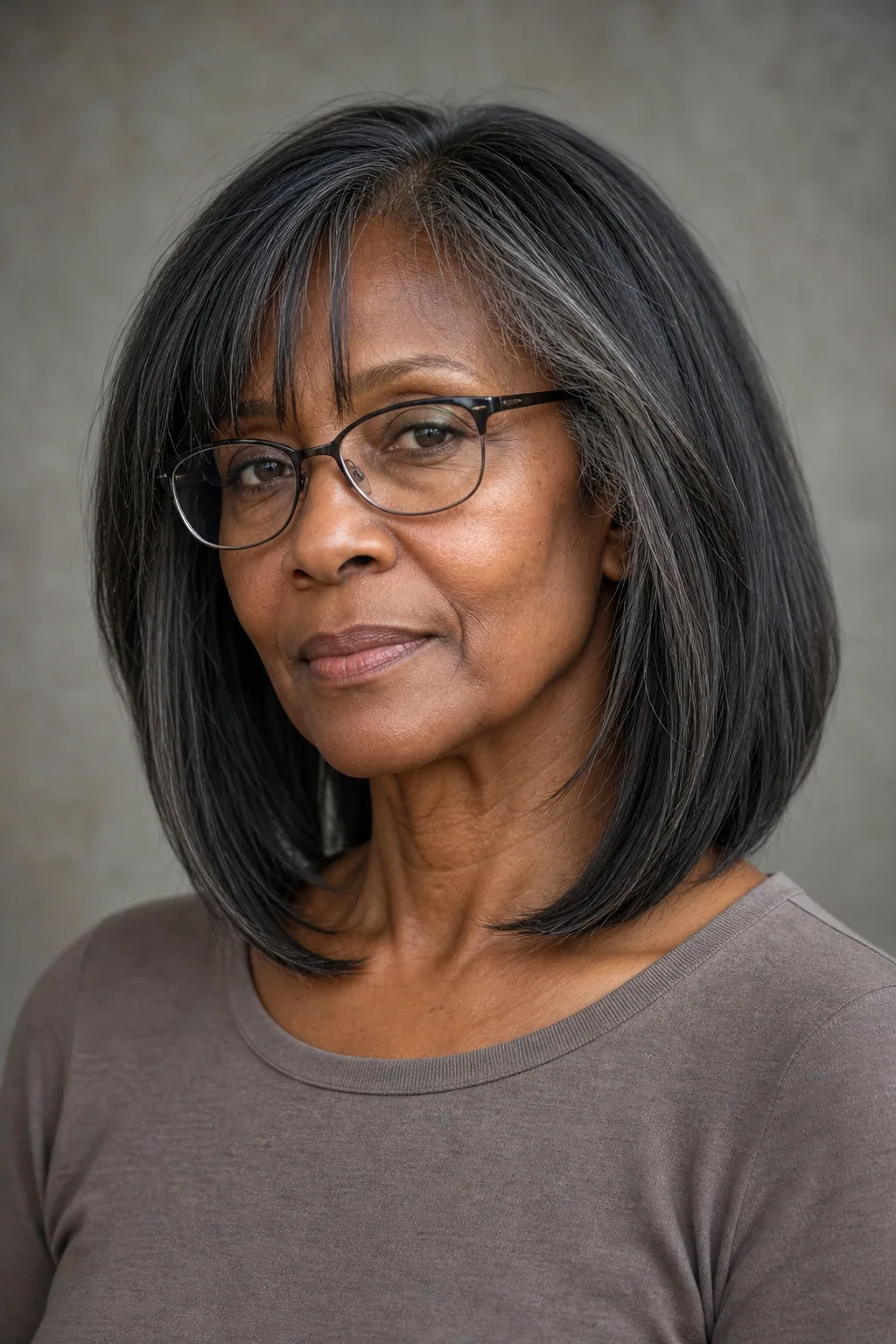
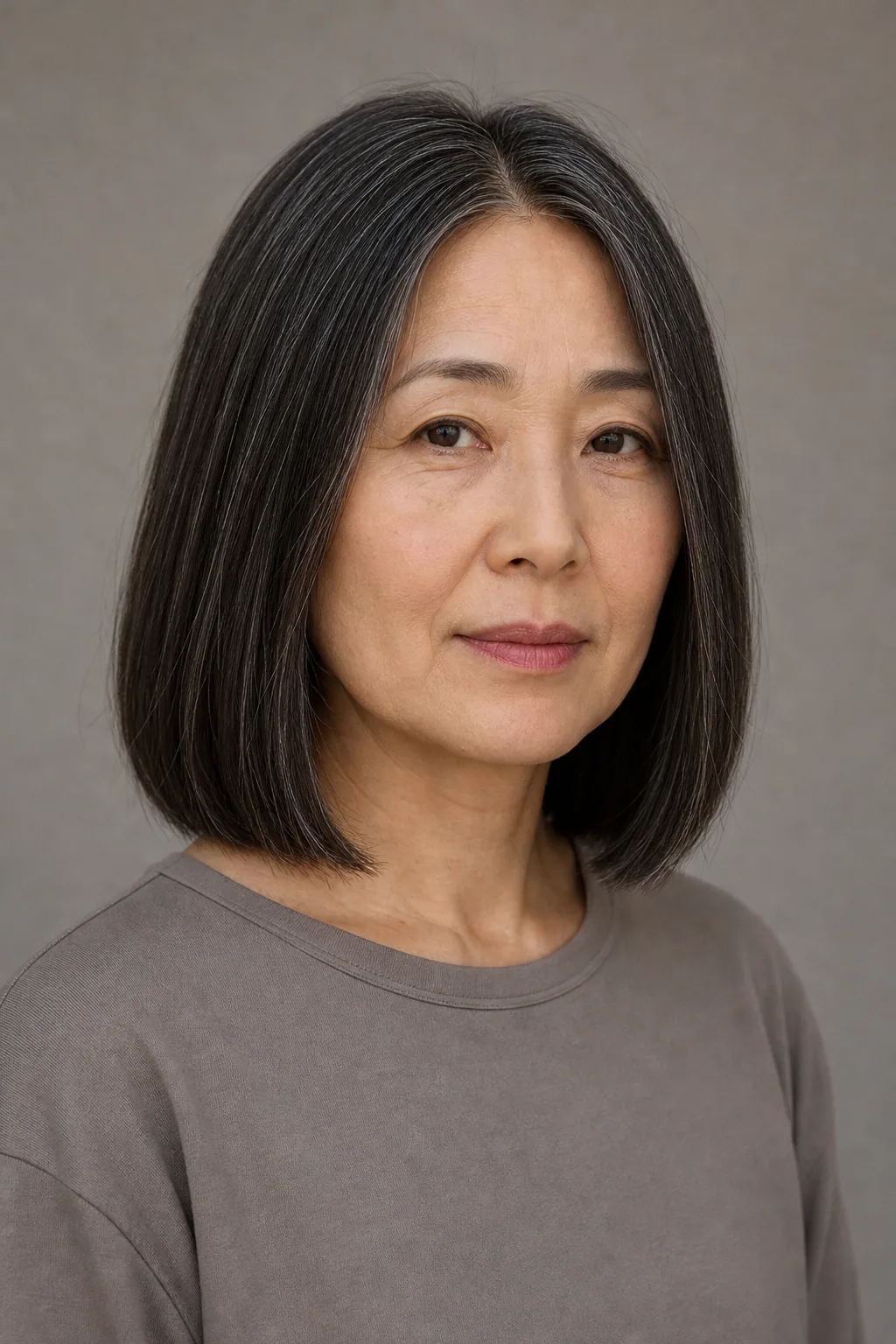
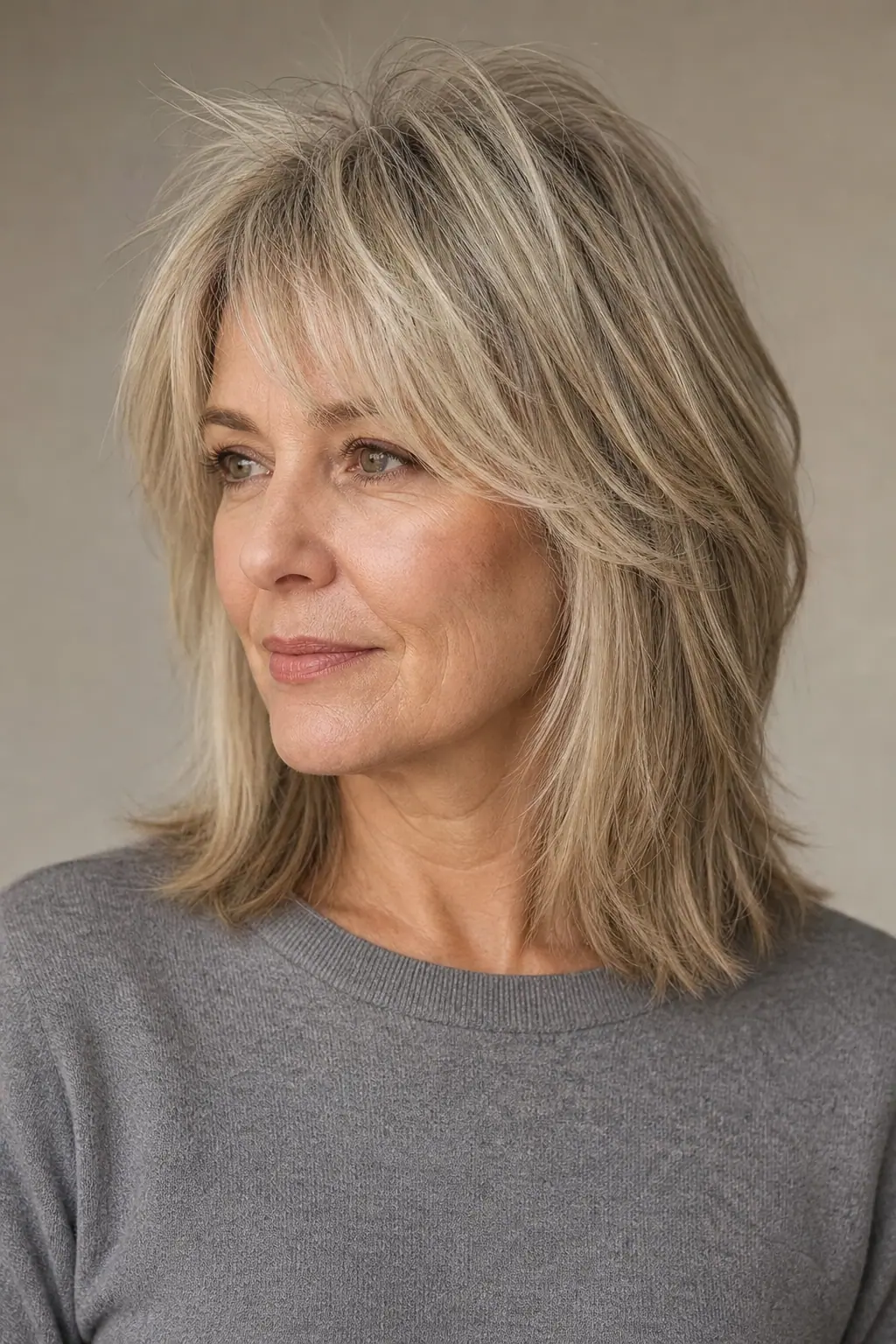
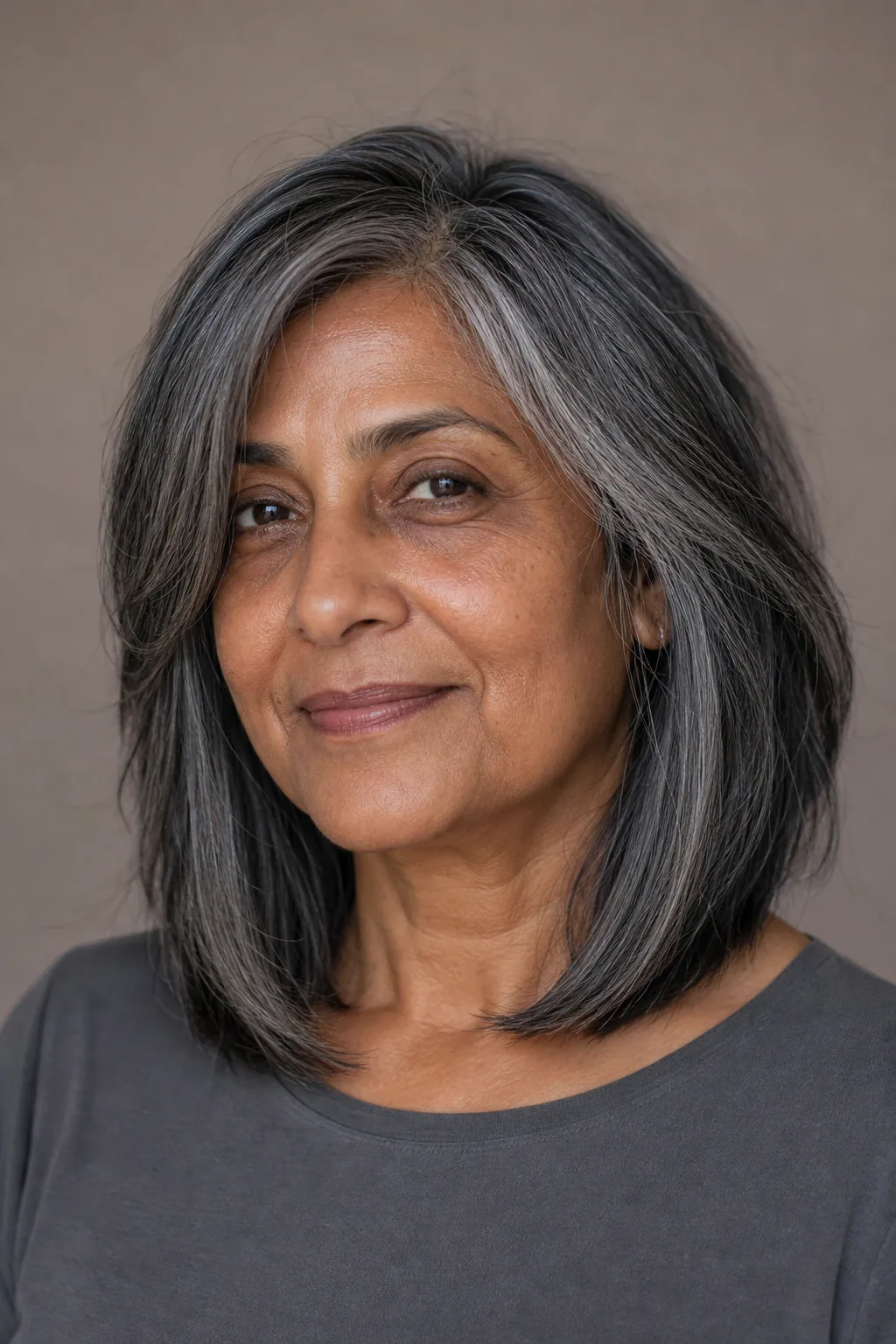
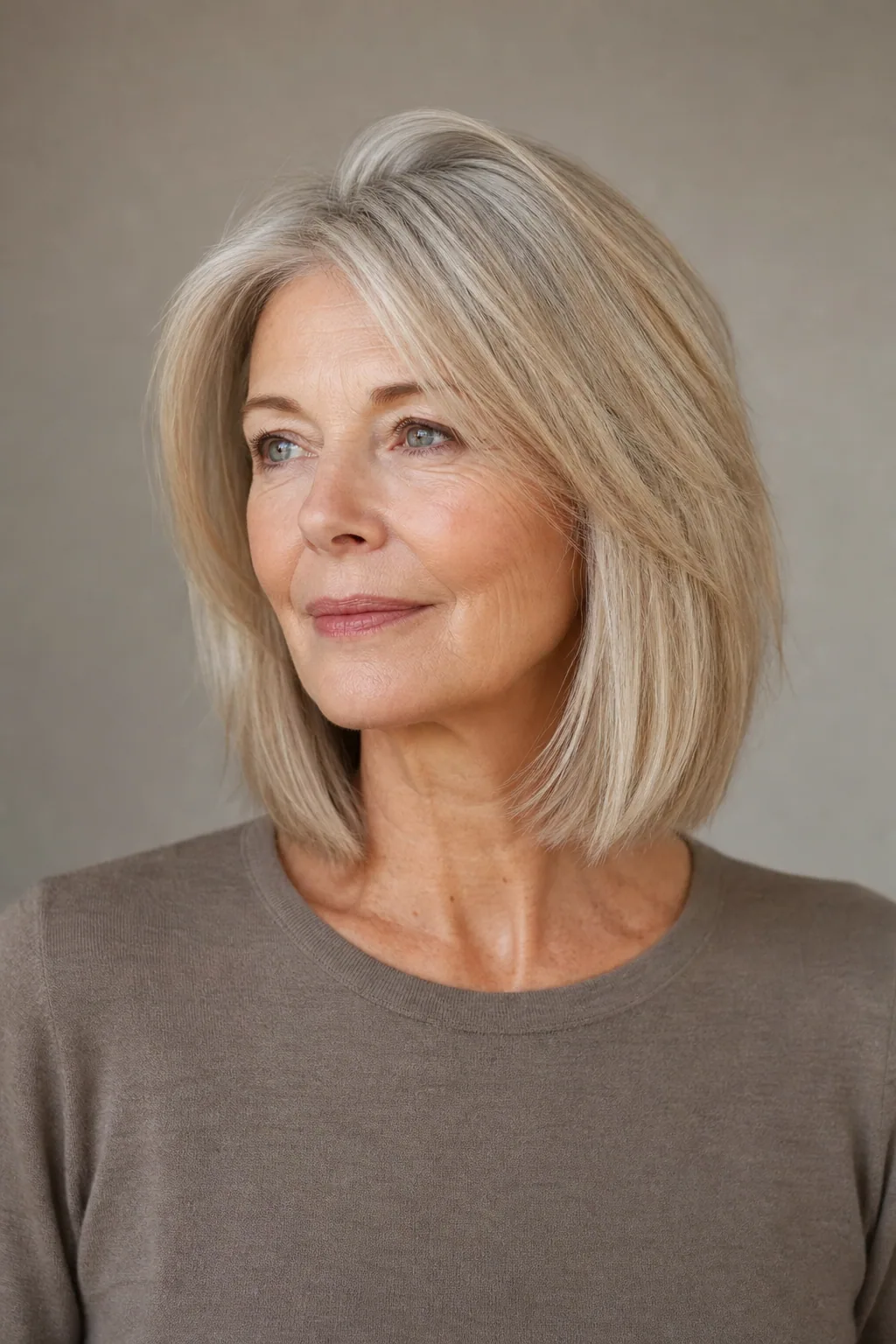
Hairstyle images in this guide are AI-generated illustrations, not photos of real clients or results. See our image standards.
Why Medium Length Works at 50
Medium length works at 50 because it is the one range where you can have lift at the crown and full ends at the same time. Long hair pulls the top flat under its own weight. Short hair is quick but leaves little to tie back. Between the jaw and the collarbone, the stylist can build height where hair has started to thin and still leave the bottom edge thick. A cut changes how full hair looks, not how much there is, and this is the length that gives it the most to work with.
Three things happen at once in the early 50s, and medium length answers each:
Density moves. The hair can look thinner at the part, the crown and the temples while the lengths still look healthy. Layers placed high take weight off the top, and a solid perimeter keeps the outline thick.
The jawline softens. A heavy line sitting right on the jaw drags the eye down. A medium cut puts the weight line above or below the jaw, where it lifts instead.
You still want to tie it back. A ponytail needs about three inches of length behind the ears. Medium cuts keep that, and short cuts don't.
The in-between length. Between the shoulder and the bust line there is a stretch, from one to three inches below the collarbone, that stylists call the in-between length. It is long enough for a low ponytail and a half-up clip, short enough that the ends don't thin out and trail. Hair that used to be worn at mid-back often lands here at 50. It is the length most women mean when they say "I want to keep it long, but not that long."
Jaw, Shoulder, Collarbone or In-Between: Choosing Your Length
Choose your length by what you want to keep: the tie-back, the swing or the fewest minutes. Hair length does more than set the style. It decides how much weight pulls on the roots, and how much the ends show their age. Use these three questions first:
Do you need to tie your hair back for work, exercise or sleep? Choose the collarbone or the in-between length.
Does your hair go flat on top and heavy below? Choose the shoulder or the jaw, where the weight is lighter.
Do you want the fewest salon visits? Choose the collarbone or the in-between length, which trim well every 8–10 weeks.
Length
What it does at 50
Best for
Tie back?
Trim every
Jaw (chin to jaw line)
Lightest on the roots, so the crown holds lift easily
Fine or thin hair, a softening jaw, wanting a change from long
A half-clip only
6–8 weeks
Shoulder (resting on the shoulder)
Frames the face and swings; often flips against a collar
Medium density, lobs, wavy hair
A low pony, mostly
6–9 weeks
Collarbone (grazing the bone)
Good weight at the ends and easy to shape
Most densities, face-framing layers
Yes, ponytail or clip
8–10 weeks
In-between (1–3 inches below the collarbone)
Keeps the "long" feeling, with ends that still hold their body
Medium to thick hair, going from long, anyone who wants a tie-back
Yes, any style
8–10 weeks
If your hair falls past the bust line, you're in long-hair territory, and the questions change. Ask your stylist where the in-between length would land on you before you commit to the first cut.
Lobs and Collarbone Cuts
A lob, or long bob, is the quickest way into medium length, because it keeps a clean outline and changes only where the hair ends. These four use the perimeter, the part and the length of the front to shape the face.
1. In-Between Cut Just Below the Collarbone
The hair ends one to three inches below the collarbone, so it clears the shoulder when you turn your head and still pulls into a ponytail. The bottom edge is cut almost straight with the corners softened, and any layers sit on the underside, which keeps the ends thick. It suits medium to thick hair and women growing down from long. Ask for "just below the collarbone, solid ends, nothing taken off the bottom."
2. Textured Lob With Bent Ends
This lob rests on the top of the shoulder, and the ends are cut on a slight bevel, a little shorter underneath, so they bend in toward the neck without a round brush. The surface is cut dry so the stylist can see where the hair separates. It suits straight to slightly wavy hair that tends to flip out at the shoulder. Ask the stylist to check the length with your head level and again with your chin down, because that is where a lob either swings or kicks.
3. Collarbone Cut With a Concave (Slightly Longer) Front
A concave perimeter curves like a shallow bowl: the front pieces are cut an inch or two longer than the back, so the line slopes toward the face. It frames a softening jaw without the shortened back of an angled bob, and the weight stays at the nape. It suits hair that looks heavy and square at the bottom. Ask for "a soft curve, front longer than the back, not a stack."
4. Blunt Lob With a Middle or Side Part Switch
As the part widens, many women move it from one side to the other, or to the middle, to hide the line. This lob is cut with the hair dry and parted both ways, so the line holds whichever you choose. A side part lifts the crown, and a center part is calmer and shows more face. It suits straight hair with a clean, dense edge. Ask for "cut it to work with a center part and a side part."
Layered Mid-Length Cuts
Layers are a placement decision, not a quantity: the question is where the shortest one starts and what is left alone below it. Medium length layered haircuts at 50 do best with movement high and a full perimeter. These four place the layers at the crown, the chin, the underside and the mid-lengths.
5. Mid-Length Layers With Lift Cut Into the Crown
The layers begin at the crown, not the face, and are short enough to stand up from the scalp. Everything below the cheekbone stays one length. The stylist lifts each section straight up from the head before cutting, so the top has height without teasing. It suits hair that is flat at the crown and dense at the ends. Ask to see the shortest layer held up before it is cut, because one cut too short shows at the part.
6. Long Face-Framing Pieces From the Chin
Some women find layers that start at the cheekbone too short beside the face. Here the first piece starts at the chin and falls to the collarbone, cut long and slightly curved so it tucks behind the ear. It adds shape at the temples, where density can drop first, without adding short ends. It suits a stronger jaw and anyone who has never liked "face-framing." Ask for "pieces that start at my chin, not my cheekbone." More on movement at the face: youthful hairstyles over 50.
7. Medium Cut With Ghost Layers for Fine Hair
Ghost layers are cut into the underside of the hair, where they can't be seen. In most cuts they take weight out. Here they do the opposite for fine hair: two or three short layers sit under the crown, so they prop the top up like a shelf. The surface stays one length and the perimeter stays blunt. It suits fine hair that lies flat the day after a wash. Skip any thinning shears.
8. Shoulder-Length Cut With Swingy Ends for Thick Hair
Thick hair rests on the shoulder and stays heavy. The fix is to take weight out of the mid-lengths, with internal layers or slide cutting, and hold the perimeter, so the ends swing instead of sitting like a block. It suits thick, straight to wavy hair that feels like a hat. Ask for "weight out of the middle, not the ends." A blow-dry with a 1.5–2-inch round brush finishes it in about ten minutes.
Medium Length With Bangs
Bangs at 50 soften the forehead and the temples, and at this length they blend into the sides. Both of these depend on your hairline, so check for a cowlick first.
9. Medium Length With a Wispy Side Fringe
The fringe is cut on a diagonal from a deep part, so it covers one temple and fades into the side layers. It is light enough that the forehead shows through, and long enough to tuck behind the ear. On a lob or collarbone cut it grows into face-framing pieces in about eight weeks, so there is no awkward stage. It suits straight and wavy hair. Ask for "a diagonal fringe from my part, cut dry, so I can tuck it."
10. Shoulder Cut With Brow-Grazing Bangs
Brow-grazing bangs skim the eyebrows, with a slight curve so they sit softly, and blend into a shoulder-length cut. They suit a high forehead and straight hair. Before you commit, do the cowlick test: dampen the hairline, comb the hair forward and see where it goes. If it springs up or splits, skip them. With glasses, ask for the bangs to end just above the top rim. For frame by frame advice, see hairstyles for women over 50 with glasses.
Wavy and Curly Medium Cuts
Wave and curl shrink as they dry, so a medium cut for textured hair is judged dry, not wet. Both of these keep the cut simple and let the pattern do the work.
11. Medium Wavy Cut With Weight Kept at the Ends
A wave that appears in the 50s often forms only at the ends, where the hair is oldest. This cut is dry-cut, with no layers above the chin, so the weight stays at the bottom and holds the wave together instead of letting it fall flat or frizz. The bottom edge is cut in a soft U, a little longer at the sides, to stop it forming a triangle. It suits waves that go limp when layered. Apply a leave-in cream and don't touch it as it dries.
12. Mid-Length Curls and Coils With Crown Lift From the Finish
Here the cut stays close to one length, with only a few layers through the top cut curl by curl, and the volume at the crown comes from the way it is dried. Lift the roots with a pick or fingertips, clip the crown with two or three duckbill clips as it dries, and diffuse on low. It suits curls and coils that flatten at the roots, and it avoids a cut that takes too much from the top. Allow for shrinkage: mid-length stretched can sit at the jaw dry.
Styling Medium Hair at 50 in Ten Minutes
A ten-minute morning for medium hair is a short sequence, not a full blow-dry: dry the roots, shape the ends, then fix the shape in place. These three work from the jaw to the in-between length.
A flat-wrap blow-dry. Dry the hair to about 80 percent with the nozzle pointing down, then use a paddle or vent brush and wrap each section flat around the head, from the front to the nape. It lies smooth, with a gentle inward bend, and it takes about eight minutes. Good for straight hair and for entries 1, 4 and 8.
A 1–1.5-inch curling iron bend. Take two-inch sections from the top and bend only the last two to three inches, leaving the iron open at the end, rather than curling the whole length. It adds body to straight, fine hair in under ten minutes. Use a heat protectant and a medium setting, not the highest. Works for entries 2, 3 and 7.
The five-minute braid or claw clip. For work days or the gym, a single loose braid at the nape gives a neat finish without a hairstyle. A half-up claw clip, with the top section lightly teased at the base before it is clipped, lifts the crown and keeps the length down. For an occasion, mother of the bride hairstyles show how to build a full updo from a medium cut.
Going From Long to Medium
Going from long to medium is easier in two steps than in one: land at the in-between length first, then decide whether to go shorter. If your hair has been long for years, the first cut is the hardest, because the weight changes how everything falls.
How much to take off. Cutting four to six inches usually takes you from past the bust to the in-between length. A cut to the shoulder is another three inches. If you're nervous, stop at the in-between and return in 8–10 weeks.
Where the first layers go. Keep the first layers high, at the crown, or at the chin, and leave the bottom two inches alone. Layers at the shoulder or below can thin the ends fast.
The ponytail trick. Some stylists tie the hair in a low ponytail, cut the tail's length off, and then shape the rest. It gives a clean, even perimeter and a visible amount to remove. Ask whether she works this way.
Keep the line solid. The bottom edge should be cut straight, then softened at the corners. A chopped or razored edge makes the ends look thinner than they are.
A cut like this grows out evenly if you change your mind. If you want to go further, haircuts for women over 40 cover the long and medium cuts a decade earlier, with a section on when an outgrown cut no longer fits.
Choose by Face Shape
Medium length frames the face from the chin down, so the front length and the first layer do most of the shaping. For the full method, see how to choose a haircut for your face shape.
Face shape
Good picks here
Key detail
Avoid
Oval
1, 4, 11
Most medium cuts work; choose by hair type
Heavy bangs that hide the forehead
Round
5, 6, 3
Height on top and length past the chin lengthen the face
A blunt line ending at the cheek
Square
3, 6, 9
A curved front and a soft fringe round the corners
A blunt cut ending exactly at the jaw
Heart
1, 2, 8
Weight at the collarbone balances a wider forehead
Short layers and volume at the temples
Long
2, 8, 10
Width at the sides and a fringe shorten the face
Straight, one-length hair past the collarbone
Choose by Hair Type
Match the cut to strand thickness (fine or coarse) and density (how many hairs there are), because fine and thin are not the same.
Fine hair (narrow strands, any density): a blunt perimeter and a few high layers. Entries 1, 3 and 7.
Thin hair (lower density, scalp shows at the part or crown): length at the jaw or shoulder, a solid edge and lift at the crown. Entries 2, 4 and 5. If the loss is sudden or patchy, see a board-certified dermatologist.
Thick hair: weight taken from the middle and the perimeter left alone. Entries 1 and 8.
Coarse or gray hair: clean ends, a smoothing cream and a long piece or two to release weight. Entries 3 and 6.
Wavy hair: cut dry, and no layers above the chin. Entry 11.
Curly and coily hair: cut dry, curl by curl, and finished to lift the roots. Entry 12.
What to Ask Your Stylist
Bring the words, not just a photo: where the length lands, how the ends are cut and where the first layer starts. Say these out loud:
"I want it just below my collarbone, with the ends left solid."
"Start the first layer at my chin, and leave the bottom two inches alone."
"Cut it dry, parted the way I wear it, and show me before you remove length."
"I want lift at the crown, but not at the cost of the ends."
"I wear glasses. Keep the fringe above the top of the frames."
"Tell me when I'll need the next trim, and how it will look in between."
Maintenance and Styling Reality
Medium cuts trim every 6–10 weeks and take 5–15 minutes to style, a good middle ground between short cuts and long. Pick the trade-off that fits your week.
Cut (entries)
Trim every
Daily styling
Products and tools
Grow-out
In-between and collarbone (1, 3)
8–10 weeks
8–12 minutes
Heat protectant; paddle or vent brush
Very easy
Lobs (2, 4)
6–9 weeks
5–10 minutes
Light cream; 1–1.5-inch curling iron
Grows evenly
Layered (5, 6, 7, 8)
7–9 weeks
8–12 minutes
Root-lift spray; 1.5–2-inch round brush
Layers join the length
Fringe cuts (9, 10)
8–10 weeks (fringe 3–5)
5–10 minutes
Light cream; small round brush
Fringe joins the layers
Wavy (11)
8–10 weeks
5–10 minutes
Leave-in cream; diffuser on low
Keeps its shape
Curly and coily (12)
8–10 weeks
10–15 minutes
Curl cream; duckbill clips; pick
Edge grows evenly
Frequently Asked Questions
Is medium length hair flattering after 50?
It is, when the weight line sits above or below the jaw, not right on it. At that length the stylist can add lift at the crown and keep the ends full, which suits most face shapes and densities. It drags only when the ends are thin and the hair is one flat length.
Is a lob a good haircut for women over 50?
Yes, if it is cut with a solid perimeter and a little movement at the front. A lob is easy to air-dry or tuck, and it lets the hair grow out evenly. Ask your stylist to check that it doesn't flip against your shoulders when you move.
Should I go from long to medium at 50?
Only if you want to. Long hair can look as good at 50 as at 30, as long as the ends are full. Medium helps if the weight is pulling the crown flat, or if the last few inches look see-through. Go in two steps: the in-between length first, then a trim.
What medium length haircut suits fine hair over 50?
A blunt collarbone cut with two or three short layers under the crown to prop it up. Fine means narrow strands, and it holds a cut best when the edge is solid. Avoid razor cutting and thinning shears, which make fine ends look wispy.
Do layers make medium hair look thinner?
They can, if they reach the bottom edge. Layers cut into the perimeter remove the thickness that makes the ends look full. Layers placed at the crown or the chin, with the bottom two inches left alone, add height and keep the outline.
How do you style medium hair quickly?
Dry the roots with the nozzle pointing down, then wrap each section flat around the head with a paddle brush. Finish with a bend at the ends from a 1–1.5-inch curling iron. The whole routine takes eight to ten minutes.
Can medium length hair be worn up?
From the collarbone down, yes: a ponytail, a braid, a claw clip or a low twist. At the jaw you get a half-clip at most. Ask your stylist to cut the back a little longer than the front if you want to wear it up often.
Results vary with hair type, density, texture and face shape. This guide is educational and is not a substitute for an in-person consultation with a licensed stylist.
 Grace